Have you ever considered that there are backyard weeds that birds love? Maybe not. We too often view weeds as a nuisance, and when spring season arrives, we’re ready to pull, mow, or spray the intruders. But to birds, these scrappy invaders are a haven for several reasons.

Many common weeds we find in our backyards provide essential food in the form of seeds and fruits. When the leaves fall and form dense debris on the ground, they harbor insects and other crawling worms that are a protein-rich buffet for birds.
Apart from supporting their foraging habits, some of these weeds also offer temporary low-ground shelter. Ultimately, you can conclude that weeds, however troublesome, are an important part of the food chain.
So, before you clear out these plants, read our post, and find out how much fauna they are sustaining every season. Hopefully, it helps you make more bird-friendly choices in your own backyard.
1. Dandelions (Taraxacum officinale)
- Scientific Name: Taraxacum officinale
- English Name: Dandelion or Common Dandelion
- Annual or Perennial: Perennial
- Grass, Sedge, or Broadleaf: Broadleaf
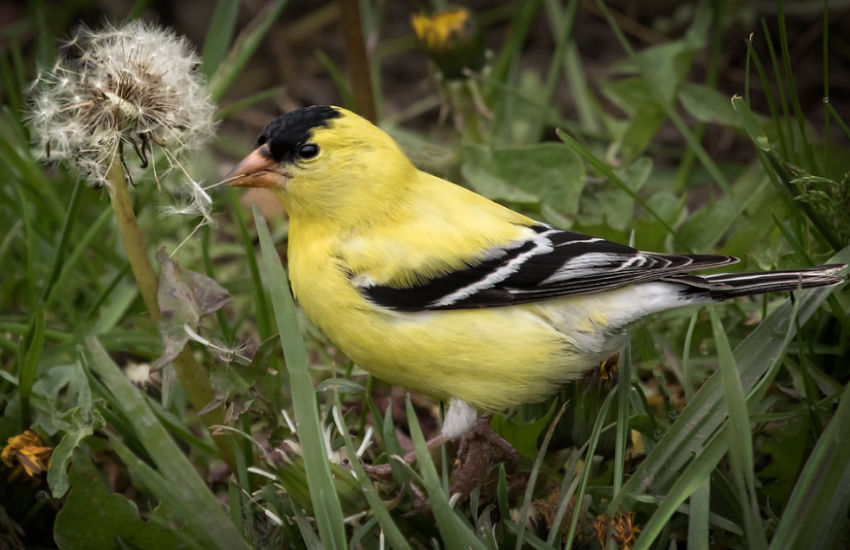
Dandelions are one of the first weeds to sprout in backyards every spring. This makes them an early food source for insects, which in turn feed insectivorous birds.
Once the flowers set seed, their fluffy seed heads become a favorite food for birds such as the finches and sparrows.
Additionally, dandelions also draw aphids, beetles, and ants, attracting starlings and robins for the protein-rich food.
2. Chickweed (Stellaria media)
- Scientific Name: Stellaria media
- English Name: Chickweed, Birdweed, Chickweed, Chickenwort, or Common Chickweed
- Annual or Perennial: Annual
- Grass, Sedge, or Broadleaf: Broadleaf
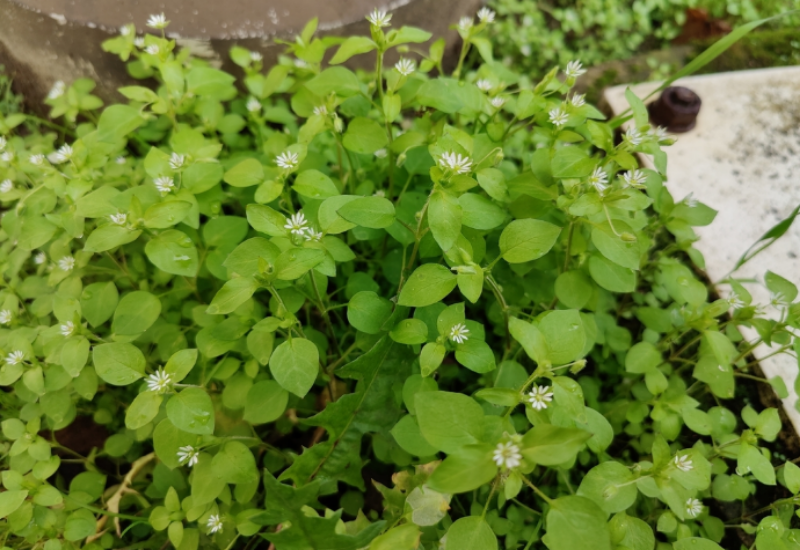
The cool-annual weed is easy to recognize by its many mats in shady, moist areas. It is also known to be a chicken’s favorite, hence the name.
Ground-feeding birds like sparrows, doves, starlings, and robins sometimes feast on the seeds and tender, succulent leaves.
Chickweed also provides a cool mat that shelters insects (another food source), especially important for birds like Dark-Eyed Juncos during the breeding season.
3. Crabgrass (Digitaria spp.)
- Scientific Name: Digitaria spp.
- English Name: Crabgrass
- Annual or Perennial: Annual
- Grass, Sedge, or Broadleaf: Grass
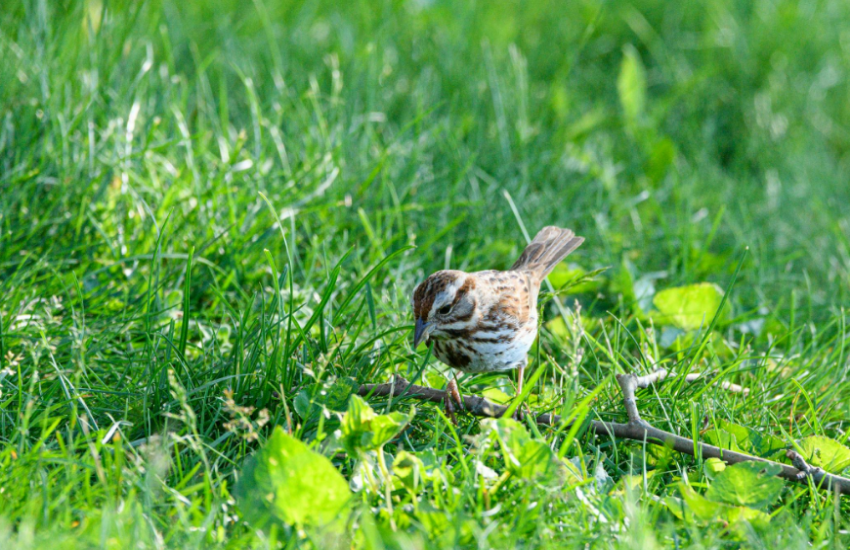
Crabgrass tops the list of the most loathed weeds in most backyards. Yet, the sheer species of birds that love the common Crabgrasses, Smooth Crabgrass (Digitaria ischaemum) and Large Crabgrass (Digitaria sanguinalis) is surprising.
In late summer, for instance, its seed heads ripen into a favorite snack both for domestic birds like chickens, migrating birds like geese, and other ground-feeding birds like doves, finches, and sparrows.
The grass blades also host insect larvae that attract young birds, including song birds who heavily rely on the larvae and other bugs during breeding season and when feeding their young.
4. Ragweed (Ambrosia artemisiifolia)
- Scientific Name: Ambrosia artemisiifolia
- English Name: Ragweed, Common Ragweed, Carrot Weed, or Hay Fever Weed
- Annual or Perennial: Annual
- Grass, Sedge, or Broadleaf: Broadleaf
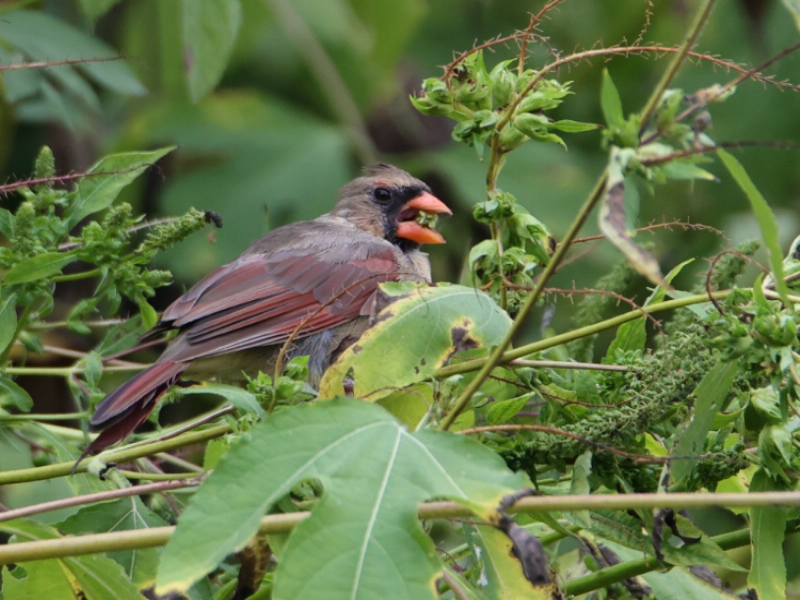
Ragweed might be infamous for triggering allergies, but birds are less concerned with its negative effects, as it is one of the top backyard weeds that birds love.
Its tiny seeds are high in fat and a critical food source for many birds getting ready for migration, such as blackbirds and towhees.
Song birds such as cardinals and goldfinches and game birds like quails, rick-necked pheasants, scaled quails, and doves also eat the oil-rich seeds in the winter.
Ragweed seeds are, in fact, more nutritious than commercial bird seeds and readily provide energy when the birds need it most.
5. Lamb’s Quarters (Chenopodium album)

- Scientific Name: Chenopodium album
- English Name: Lambsquarters, Goosefoot, White Goosefoot, or Pigweed
- Annual or Perennial: Annual
- Grass, Sedge, or Broadleaf: Broadleaf
You may find lambsquarters in your garden or a newly disturbed area in your backyard. What you may not know is that the close cousin of quinoa springs up with plenty of good nutrition for birds to love.
The weed produces an abundance of small seeds (containing iron, potassium, vitamins, and dietary fiber) that attract sparrows, goldfinches, and buntings.
What makes Goosefoot a good foraging plant is that it also grows tall, providing both food and shelter. Their vertical structure improves bird habitat diversity in otherwise flat garden beds and lawns.
6. Shepherd’s Purse (Capsella bursa-pastoris)

- Scientific Name: Capsella bursa-pastoris
- English Name: Shepherd’s Purse
- Annual or Perennial: Annual
- Grass, Sedge, or Broadleaf: Broadleaf
This cool-weather weed is a common sight in gardens, lawns, and hedgerows. Numerous birds don’t mind its cress-like scent once the poultry are done nibbling on the leaves.
Goldfinches, grouses, sparrows, doves, and chaffinches are some of the small birds that relish the small, heart-shaped seed pods.
The weed also attracts pollinators, small insects, and larvae from weevils and leaf-mining flies, adding another source for insect-eating birds.
7. Foxtail (Setaria spp.)

- Scientific Name: Setaria spp.
- English Name: Foxtail
- Annual or Perennial: Annual
- Grass, Sedge, Broadleaf: Grass
Foxtail, an annual grass weed with a distinct, narrow, and cylindrical panicle, is another common weed that birds love.
The bushy seed heads are a preferred food source for a variety of birds, including finches, doves, rusty blackbirds, bobwhite quails, sparrows, buntings, dickcissels, and many more.
Foxtail grasses also attract grasshoppers, fleas, stinkbugs, and aphids, which add to the variety of food birds can enjoy, especially in late summer and early fall when other food sources are declining.
8. Plantain (Plantago major)
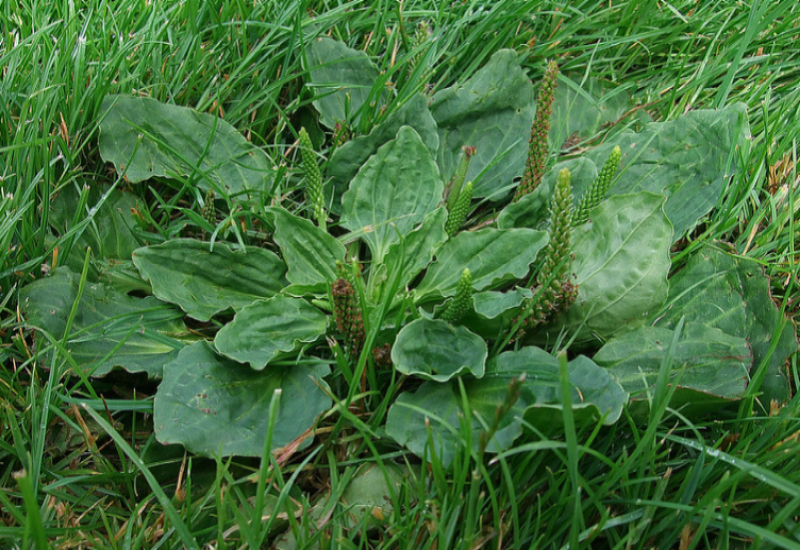
- Scientific Name: (Plantago major)
- English Name: Plantain, Cart Track Plant, Great Plantain, or Broad-Leaved Plantain
- Annual or Perennial: Perennial
- Grass, Sedge, Broadleaf: Broadleaf
Plantain is a common lawn and field weed that can persist through traffic, both from humans, bugs, and birds.
Its tall spikes produce over 20,000 seeds, orange to black and bitter-tasting to humans, but are a hit with sparrows, juncos, doves, and cardinals. Other birds like the ruffed grouse may also eat the leaves and stalks.
Common Plantain’s leaves also offer ground cover and micro-shade that attracts bugs and keeps the soil cool, making it an ideal plant for foraging birds.
9. Smartweed (Persicaria pensylvanica)
- Scientific Name: Persicaria pensylvanica
- English Name: Pennyslyvannia Smartweed or Pink Smartweed
- Annual or Perennial: Annual
- Grass, Sedge, or Broadleaf: Broadleaf
Smartweed is often found in the backyard, especially in damp soil near drains or fence rows. It produces long flowers, inviting several types of insects such as bees, butterflies, flies, beetles, and wasps.
So, apart from nibbling the black and shiny seeds the weed produces, as sparrows, mallards, and cardinals would do, they can add the protein-rich insects and amphibians that rest on flexible stems to their bounty.
10. Spotted Spurge (Euphorbia maculata)

- Scientific Name: Euphorbia maculata
- English Name: Spotted Spurge, Prostrate Spurge, or Spotted Sandmat
- Annual or Perennial: Annual
- Grass, Sedge, or Broadleaf: Broadleaf
While spurge itself is unfriendly to humans and pets, the low-growing mats are a favorite spot for pollinator insects, ants, and other insects that many birds love snacking on.
The early and fast springer is especially beneficial to wrens, warblers, bluebirds, and robins that prefer to forage close to the ground.

Lead Editor for Insight Weeds.