Echinochloa crus-galli is a warm-season grass that can grow up to 1.5m tall. It reproduces by seed and is considered one of the world’s worst weeds in rice cultivation. This grass is also a common weed of pastures, roadsides, ditches, and other disturbed sites.

You can easily identify it by its coarse, pale green leaf blades with prominent midveins and pointed tips, liguleless collar, red-tinged stems, and a bushy, branched panicle.
Barnyard Grass Classification
- Domain: Eukaryota
- Kingdom: Plantae
- Phylum: Tracheophyta
- Subphylum: Angiospermae
- Class: Monocotyledonae
- Order: Poales
- Family: Poaceae
- Genus: Echinochloa
- Species: Echinochloa crus-galli
- Common Names: Cockspur Grass, Barnyard Millet, Water Grass, Panic Grass, and Japanese Millet
Nativity and Distribution
Barnyard Grass is native to Asia and Europe. It has since been introduced in other regions, including:
- Southern Canada
- United States
- Northern Mexico
Physical Characteristics
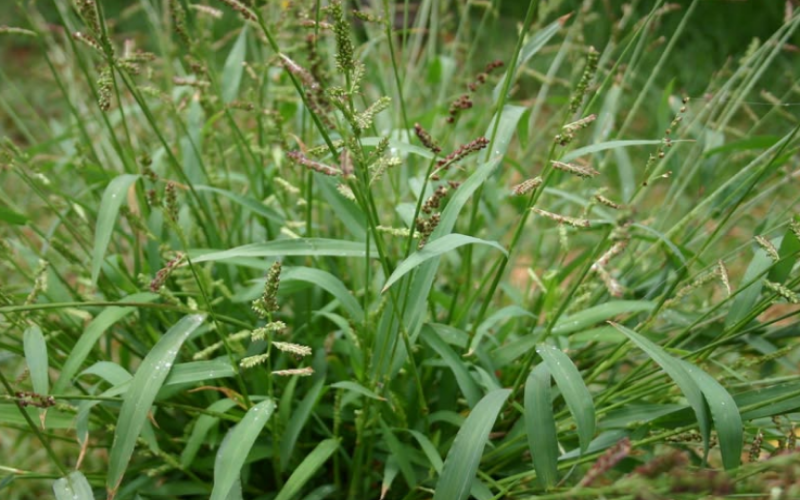
- Leaves: Flat, rolled in a bud with a sharp point, about 2-6 inches long
- Fruits: Spikelets, 3-4 mm long, densely arranged on branches
- Stems: Upright or sprawling and branching at the base
- Flowers: Densely clustered, knot-like flowers, 6-25 cm long
- Roots: Fibrous root system
Barnyard Grass is a warm-season grass that can grow up to 1.5m tall. It is identifiable by its coarse, pale green leaf blades with prominent midveins and pointed tips, liguleless collar, red-tinged stems, and a bushy, branched panicle.
Leaves are flat, broad, and elongate, 30-50 cm long and 1-2 cm wide. You can identify this annual from other warm-season grasses by its coarse texture, pale green colour, and lack of ligule in the junction between the leaf blade and the sheath.
Culms are upright or sprawling, round to flattened in cross section, and branching at the base, growing about 0.8-1.5m tall. They are rather thick, hairless, and have a reddish tinge at the base.
The spikelets are oval, often long-awned, and measure approximately 3-4 mm in length. They are densely arranged in panicles, pale green to dull purple in colour, and contain florets with seeds. Flowering occurs between July and September.
The seed is ovate, shiny, with a pointed tip, about 1-2mm long, and tan to brown in colour.
Reproduction, Dispersal, and Life Cycle
- Life Cycle: Annual
- Seeds: A single plant can produce 40,000 seeds
- Climate: Temperate and tropical climates
- Dispersal: Animals, water, birds, machinery and as a seed contaminant
Cockspur Grass behaves as an annual, thriving in temperate and tropical climates. This grass propagates by seed, with each plant producing approximately 40,000 seeds per year.
The seeds are thought to be mainly dispersed as a contaminant in grains. Other dispersal methods include water, animals, birds, transfer of soil, and contaminated machinery and shoes.
Barnyard Grass is adapted to a variety of soils, including wet soils and diverse sunny areas. It can tolerate moderate drought and partial shade. Seed germination begins in spring, and vegetative growth continues well into summer.
Seeding begins in July, and by early fall, it begins to turn brown. Later in the season, the grass dies off due to frost. When favorable conditions return in spring, the seeds produced in late summer and early fall give rise to new plants.
You’re likely to find Barnyard grass in utility lawns, pastures, cropping systems, ditches, and other disturbed sites.
Similar Plants
- Echinochloa colona
- Echinochloa oryzicola
- Sorghum halepense
- Panicum dichotomiflorum
Uses
- It is used as cattle fodder and also cut for hay.
- The grass is used for land reclamation in saline and alkaline regions in Egypt.
- It is an important food source for wild animals like deer and rabbits.
- Young shoots and grain are consumed in times of scarcity.
- A boiled concoction of the grass roots is used to treat indigestion in the Philippines.
- Barnyard grass is used as a traditional remedy for spleen problems, sores, hemorrhages, and wounds.
- The seeds are commonly mixed with rice grains to make rice pudding in India.
- It is consumed in South Korea to assist in lowering cholesterol and blood sugar.
Impact on Farms and Environment

Echinochloa crus-galli is considered one of the world’s worst weeds in cropping systems. It invades maize, sugarcane, and vegetables, aggressively competing for space, light, and important nutrients.
The grass often outcompetes the crops by extracting up to 80% of the nitrogen in the soil, leading to poor yields and, in some cases, catastrophic plant failure.
In paddy fields, it competes for water, heavily affecting moisture-sensitive crops. Rice yield losses in some regions can range from 20% to over 80%, depending on weed density and duration of infestation.
Barnyard Grass is susceptible to brown spot disease and is also host to aphids, parasites, and nematodes that can spread diseases, further increasing crop losses.
What makes E. crus-galli even more challenging in farms is its propensity to produce many seeds, making it a persistent weed from season to season.
Additionally, due to its ability to entangle with other crops and its similarity to the desirable plants, it can make harvesting difficult. The presence of the weed in harvested grain also reduces the quality and overall market value.
Farmers dealing with a Barnyard Grass infestation incur high manual weed control costs, as using herbicides may not always be a viable option.
When it comes to landscaping, it is not as common as other annuals like crabgrass but, where present, it can reduce the aesthetics of cool-season turf as it progressively turns brown.
In the environment, the grass forms dense growths that choke out native plants in wetlands, riparian zones, and disturbed habitats, reducing local biodiversity. Where it becomes difficult to control, it can alter the structure of ecosystems, including rice paddies and wetland margins, affecting aquatic life and bird populations.
Control
- Cultural control: Maintain a healthy lawn and solarization
- Mechanical control: Hand-pulling, digging, or mowing
- Chemical control: Herbicides like prodiamine, pendimethalin, tropemazone, and quinclorac
Maintaining a healthy lawn through proper management practices provides easy and effective control against Barnyard Grass. Where few grass plants are present, hand-pulling or using a trowel can also prove effective.
For larger infestations, mowing the lawn below 3 inches will discourage leaf and seedhead formation, hence reducing weed density.
In crop farms, options like a 40-day solarization, rotation with forage crops or winter grains, frequent cultivation, and early-season mulching can discourage or suppress growth.
Preemergence herbicides indicated for Barnyard Grass control include prodiamine, s-metachlor, EPTC, and pendimethalin.
The most effective postemergence herbicides are quinclorac, fenoxaprop-p-ethyl, nicosulfuron, foramsulfuron, and topramezone, which are selective, or glyphosate, a systemic and non-selective herbicide.
Ensure to read the label and follow the application directions based on the area or crop affected when using any of the herbicides.

Lead Editor for Insight Weeds.