Chamaenerion angustifolium is a towering herbaceous perennial in the willowherb family. It gets its name from its tendency to be the first plant to appear after a fire. Fireweed reproduces by seed.

It is easily recognized by its tall, stiff, reddish-green stems, narrow, willowlike leaves that spiral up the stem, and clusters of pink to magenta flowers.
Fireweed Classification
- Domain: Eukaryota
- Kingdom: Plantae
- Phylum: Tracheophyta
- Subphylum: Angiospermae
- Class: Dicotyledonae
- Order: Myrtales
- Family: Onagraceae
- Genus: Chamaenerion
- Species: Chamaenerion angustifolium
- Common Names: Bomb Weed, Perennial Fireweed, Narrow-leaved Fireweed, Willow Herb, Great Willow Herb, Flowering Willow, Rosebay, and Rosebay Willowherb
Nativity and Distribution
Fireweed is native to the countries in the northern hemisphere, including:
- Canada
- Northern United States
- British Isles
- Temperate Asia
Physical Characteristics
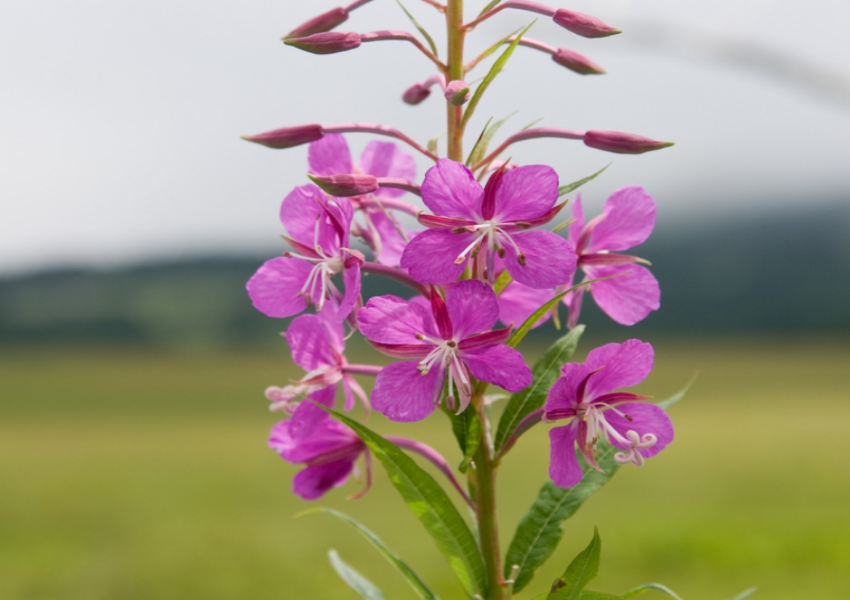
- Leaves: Narrowly lanceolate, spirally arranged, 5-20 cm long
- Fruits: Elongated, many-seeded, reddish-brown pods
- Stems: Stiff, smooth, reddish-green, about 0.3-2 m
- Flowers: Terminal raceme of pink to magenta flowers
- Roots: Fibrous root system
Fireweed is a strongly rhizomatous perennial herb found in the temperate north of the globe. The wildflower gets its name from its tendency to appear first after fires.
You can identify the plant by its upright, reddish-green stems, narrow, willowlike leaves that spiral up the stem, and clusters of pink to magenta flowers.
Leaves are alternate (with lower leaves more opposite), linear or long lanceolate, willow-like, about 5-20 cm long, and spiral up the stem. They are deep green on the upper surface and pale green on the lower surface with prominent veins. The margins are minutely toothed.
Stems are simple, stiff, stout, typically about 0.3-2 m, but can occasionally grow over 2.5 m. They are often reddish-green in color, unbranched, pubescent above with small, short hairs, and glabrous on the lower surface.
Fireweed produces pink to magenta flowers with egg-shaped petals on a slender, terminal raceme that progresses from bottom to top.
The flowers are 2.5-3 cm wide with four magenta petals and four lower pink sepals, and a protruding style with four stigmas. Flowering occurs from June to September.
The seed is small, brown, and has a tuft of white silky hairs at the tip.
Reproduction, Dispersal, and Life Cycle
- Life Cycle: Perennial
- Seeds: A prolific seed producer
- Climate: Temperate climate
- Dispersal: Wind
C. angustifolium behaves as a perennial, thriving in temperate regions in the Northern Hemisphere.
The wildflower reproduces by seeds, and with a single capsule holding 300-400 seeds, a single plant can produce over 80,000 seeds. Seeds are tiny, light, and have a tuft of hair that allows for easy wind dispersal.
Once the seeds settle on disturbed ground, they germinate into new plants that further extend through rhizomes. A single plant can persist over many years to form a large patch. However, its average colonization peak is five years, and other trees and bushes will begin to overtake the weed.
Fireweed prefers nutrient-rich, well-drained soil and full sun or partial shade. While the weed can adapt to neutral, acidic, or slightly alkaline soils, it can’t tolerate poor or waterlogged soils.
It is also highly adapted to fire and quickly reproduces through seeds and underground rhizomes to overtake the burned areas.
Bomb Weed is commonly found in fields, pastures, roadsides, clearings, ravines, open woods, and burnover lands.
Similar Plants
- Lythrum salicaria
- Epibolium hirsutum
Uses

- Young shoots and leaves are consumed as cooked vegetables.
- The fresh leaves are eaten raw or fermented and consumed as tea.
- Stem fibers are used to make ropes and cords.
- The seed hairs are used as tinder for fires or as stuffing.
- Young flowers are edible and used to form a jelly in the Yukon.
- The roots are eaten raw or roasted in Siberia.
- The leaves are blended with mint or thyme and sold as a commercial tea product in Russia.
- The weed was used by indigenous people in Canada as an external remedy for eczema.
- The plant has been used as traditional medicine for colds, urinary problems, wound healing, migraine headaches, and sleeping disorders.
- It is grown as an ornamental plant in meadows and woodland, rock, or cottage gardens.
- Honey produced during the Fireweed bloom season is highly valued in Canada, Alaska, and the Pacific Northwest.
- Fireweed is used in speedy vegetation re-establishment efforts for areas that have undergone oil spills, prescribed fires, or extreme logging.
Impact on Farms and Environment
Chamaenerion angustifolium is not a serious weed in cropping systems. However, where it invades perennial crops and pastures, it can reduce yields and valuable forage grass, leading to reduced income and livestock productivity, respectively.
It can also be found in recently disturbed lands or important commercial ecosystems such as coniferous forests. If left unchecked, it can become weedy and invasive, limiting desirable seedling growth or choking out native vegetation in important habitats.
The plant is a well-known host of the root-rotting Amallaria spp., which can cause huge economic losses in commercial pine forests. Fireweed has also been observed to have allelopathic effects on lettuce.
Control
- Cultural control: Grazing in early spring and fall
- Mechanical control: Pulling and digging the rhizomes
- Chemical control: Herbicides like glyphosate and triclopyr
For a fireweed infestation in fields and pastures, grazing in early spring and again in the fall can help reduce the spread. However, this should be done under strict supervision to prevent poisoning.
For small infestations in gardens, hand-pulling before flowering and seed set can control the weed. Digging up the entire rhizome systems will help prevent regrowth and repeated weeding.
Repeated cutting and repeated spot treatments of non-selective herbicides like glyphosate can help eradicate the weed.
Consult a local extension expert for the best removal strategy if you are unsure of how to handle a fireweed infestation.

Lead Editor for Insight Weeds.