Commelina benghalensis is a creeping perennial from the spiderwort family and is native to tropical Asia and Africa. It has long, succulent stems that can grow 60-90 cm long. The plant is listed among the world’s worst weeds as it affects over 20 types of crops in many countries globally.

It is identified by its ovate leaves, fleshy, light-green stems that root at the nodes, and blue or lilac aerial flowers.
Wandering Jew Classification
- Domain: Eukaryota
- Kingdom: Plantae
- Phylum: Tracheophyta
- Subphylum: Angiospermae
- Class: Monocotyledonae
- Order: Malpighiales
- Family: Commelinaceae
- Genus: Commelina
- Species: Commelina benghalensis
- Common Names: Hairy Wandering Jew, Benghal Dayflower, Indian Dayflower, Jio, and Tropical Spiderwort
Nativity and Distribution
Benghal Dayflower is native to the Arabian Peninsula and tropical continents of Africa and Asia. Today, it is widely distributed in other regions, including the southeastern United States, Hawaii, and the West Indies.
Physical Characteristics
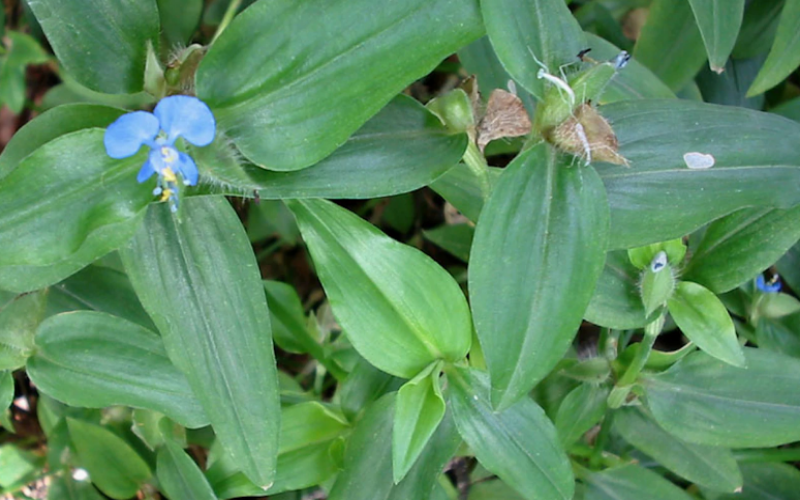
- Leaves: Ovate with entire margins and parallel leaf veins
- Fruits: Pear-shaped capsule 2.5 – 5 mm long
- Stems: Creeping, succulent, light-green stems
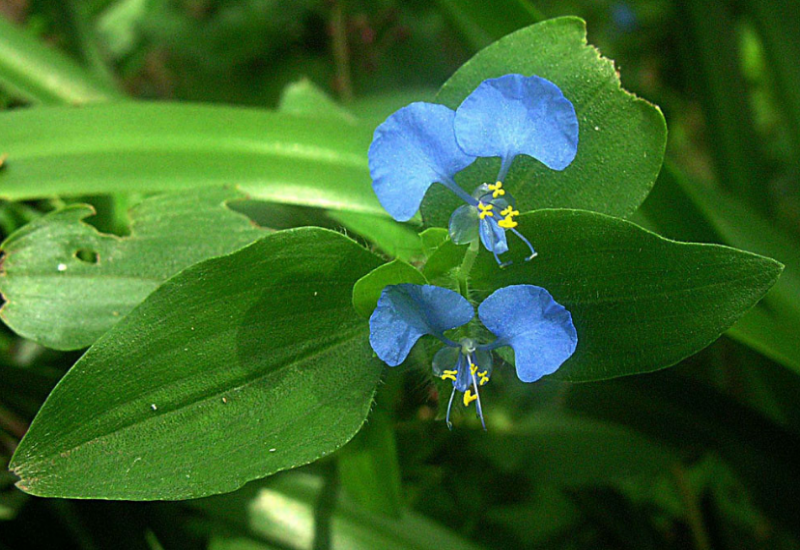
- Flowers: Funnel-shaped, blue or lilac flowers
- Roots: Fibrous root system
Commelina benghalensis is a perennial herb found in the spiderwort family. It has long, creeping or ascending stems that can grow 60-90 cm.
You can identify it by its ovate leaves, fleshy, light-green stems that root at the nodes, and blue or lilac aerial flowers.
Stems are long, round, succulent, covered with white hairs, and can grow 60-90 cm long. They often creep along the ground but can climb if supported.
The leaves are ovate to triangular, with entire margins and parallel veins. A distinct feature that sets this dayflower from other dayflowers is the presence of white or red hairs at the tip of the leaf sheaths.
Wandering Jew produces open, funnel-shaped, aerial flowers with three petals, two blue or lilac in colour and the bottom petal is light blue or white. The underground flowers develop on the rhizomes and tend to remain closed.
As a dayflower, the aerial flower opens up in the morning and wilts in the afternoon.
The plant produces aerial and underground seeds that are 2 mm long and 1.5mm wide, rectangular-shaped to ovoid, and brownish-black in colour, with a netted exterior.
Reproduction, Dispersal, and Life Cycle
- Life Cycle: Perennial
- Seeds: A single plant can produce 1,600 seeds
- Climate: Thrives best in tropical and subtropical climates
- Dispersal: Wind, birds, and humans
Benghal Dayflower behaves as a perennial but can grow as an annual in temperate climates. It can reproduce by seed. However, it is more efficient in propagating vegetatively through rooting at nodes of the stems and regrowing from stem fragments.
The stem fragments, if cut, have the ability to survive brief drought stress and can resprout if they come into contact with wet soils.
The seeds are mainly dispersed by wind, birds like doves, and humans, especially when harvesting the plant for medicinal purposes.
While the plant may not produce many seeds, they have a high fertility rate.The underground seeds tend to have faster germination rates than their aerial counterparts.
Wandering Jew prefers sandy loam soils but can adapt to diverse soil types. Additionally, the plant thrives in sunny areas but can also grow in shaded areas. Established plants can withstand prolonged drought.
Similar Plants
- Commelina diffusa
- Commelina virginica
Uses
- Young leaves and stems are cooked as a vegetable. The rhizomes are considered a wholesome food in India and Sudan.
- In Asia, it is used as a medicinal herb to treat burns, indigestion, eye aliments, to counter infertility, and thrush in infants. A plant poultice is also used to treat sore feet.
- A pounded leaf solution is used to treat diarrhoea.
- The flower sap is used to make dyes.
- It is used as animal fodder in Asia and Africa.
Impact on Farms and Environment
Commelina benghalensis is listed among the world’s worst weeds and has been declared a noxious weed in Australia and several southeastern states in the U.S.
It can invade crop farms, affecting about 25 types of crops in over 20 countries globally. Some of the most affected crops include cotton, oranges, rice, cassava, peanuts, tea, and coffee.
Hairy Dayflower is also a common weed of other landscapes and nurseries. Due to its adaptability to diverse environments and prolific spread through nodding, the weed can quickly become a problematic weed.
Established plants are especially difficult to eradicate due to their high herbicide resistance, leading to increased eradication costs and yield losses.
The weed also causes additional agriculture damage by hosting dangerous viruses like the Groundnut rosette and nematodes.
Control
- Mechanical control: Hand removal and hoeing
- Cultural control: Low mowing and mulching
- Chemical control: Herbicides like indaziflam, flumioxazin, and glyphosate
Hand removal and hoeing are only viable for very small infestations. It’s important that all fragments of the plant are removed, including the underground flowers and root fragments.
A 2-4 inch mulch or low-mowing can suppress weed establishment in early stages, but often proves tedious and largely ineffective due to its persistence and adaptability.
Depending on your area of concern, you can apply preemergence herbicides like indaziflam or flumioxazin. Postemergence herbicides like glyphosate should be applied at the seedling stage for effective control.
Combining pre- and postemergence herbicides has also been proven to effectively control Commelina benghalensis.
If you are unsure how to control this invasive weed in your landscape or farm, we recommend consulting a local extension expert.

Lead Editor for Insight Weeds.