Erigeron annuus is an annual herbaceous broadleaf that grows 2-5 feet tall. It is a common weed of lawns, roadsides, and low-maintenance areas.

It is identified by its well-branched stems that emerge from a basal rosette and daisy-like flower heads with white, thread-like ray florets and yellow disk florets.
Eastern Daisy Fleabane Classification
- Domain: Eukaryota
- Kingdom: Plantae
- Phylum: Tracheophyta
- Subphylum: Angiospermae
- Class: Dicotyledonae
- Order: Asterales
- Family: Asteraceae
- Genus: Erigeron
- Species: Erigeron annuus
- Common Names: Daisy Fleabane, Annual Fleabane, Common Fleabane, Tall Fleabane, and White Top
Nativity and Distribution
Daisy Fleabane is native to North and Central America. It has since been introduced in other regions such as Asia, Europe, India, and Korea.
Physical Characteristics
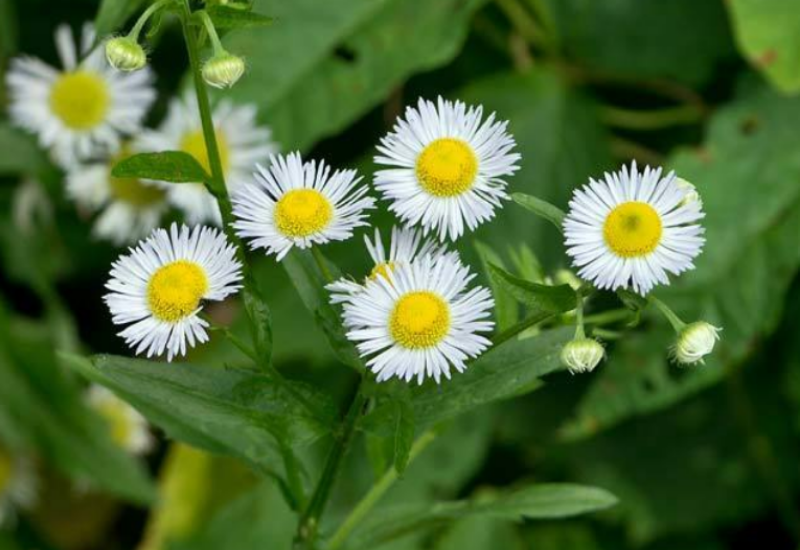
- Leaves: Large, toothed basal leaves and smaller, sessile upper leaves
- Fruits: Dry, light-brown with bristles
- Stems: Well-branched, sparsely hairy stems 0.3-1.5m
- Flowers: Showy daisy-like flowers, 2.5 cm wide
- Roots: Taproot system
Eastern Daisy Fleabane is a herbaceous broadleaf weed that can grow 60-150cm tall. It is easily identified by its well-branched stems that emerge from a basal rosette and daisy-like flower heads with white, thread-like ray florets and yellow disk florets.
The leaves occur in two forms. When young, the weed forms basal rosette leaves that are broad, light-green, slightly hairy, coarsely toothed with a pointed tip and can grow up to 5-15 cm long and 2-7 cm wide.
Middle stems are narrower, linear-shaped, hairy, smooth, and typically don’t clasp the stem. The upper leaves are smaller, alternate, lance-shaped, with a smooth outline and a pointed tip.
The stems are simple, well-branched, sparsely hairy or smooth, green in color, and can grow up to 1.5 m.
Daisy Fleabane produces showy clusters of daisy-like inflorescence at the end of the branches. They begin as rounded green buds and eventually grow to composite flowers.
Each flower is about 1-2.5 cm wide and has a central disk of yellow florets and white, threadlike 40-120 ray florets.
The stems often bend when the buds form, a phenomenon referred to as the ‘shepherd’s crook’. Rays close up in the nighttime, the bud turning into a pinkish hue until they open up again in the daytime. Flowering occurs in early to mid-May.
The seed is small, light brown, and 1 mm in length.
Reproduction, Dispersal, and Life Cycle
- Life Cycle: Annual and sometimes biennial
- Seeds: A prolific seed producer
- Climate: Temperate climate
- Dispersal: Wind, water, and human activity
Erigeron annuus is typically an annual, but in some instances, it may behave as a biennial. The herb thrives in temperate climates and reproduces by seed.
Seeds are light with pappus-like hairs that allow for effective wind dispersal. Other secondary dispersal methods are water and human movement.
The seeds are largely viable and allow the weed to aggressively colonize disturbed areas such as pastures, roadsides, abandoned fields, and waste areas.
Eastern Daisy Fleabane prefers full sun and well-drained soil, but can also thrive in partial sun where there is adequate moisture. It is tolerant of gravel and clay soils.
However, hot and dry or cold and wet weather conditions will likely cause the plant to die off.
Similar Plants
- Erigeron canadensis
- Erigeron strigosus
- Erigeron philadelphicus
Uses

- It is a popular ornamental in pollinator, butterfly, cottage, and children’s gardens.
- Young leaves are cooked as vegetables.
- Native tribes in North America used Daisy Fleabane to treat digestive and menstrual issues.
- A flower infusion was used to relieve fevers and head colds.
- The plant has been used to treat epidemic hepatitis, hepaturia, lymphadenitis, and hepaturia.
Impact on Farms and Environment
Erigeron annuus is rarely considered a serious weed in cropping systems. However, it can typically be found in pastures where it may aggressively compete with desirable grasses, reducing livestock productivity.
Since it’s a prolific seed producer and a fast-growing weed, it often requires repeated control treatments, which add to the management costs.
In diverse habitats like abandoned fields, roadsides, vacant lots, and railways, Daisy Fleabane successfully competes with native and other introduced species.
Control
- Mechanical control: Hand-pulling, mowing, and tillage
- Chemical control: Herbicide treatment containing 2,4-D and MCPA
Hand-pulling is a good control mechanism for small infestations. Ensure that you remove the entire taproot and fill the gaps with native vegetation to prevent the growth of other invasive weeds.
Mowing can reduce seed dispersion and hence the spread. Tillage in both spring and fall will also aid in the prevention of Daisy Fleabane growth.
For larger infestations, apply herbicides containing 2,4-D and MCPA on young and actively growing plants for effective control.

Lead Editor for Insight Weeds.