Mimosa pudica is a creeping or sprawling plant that typically grows about 15-100 cm long. The prickly herb is commonly known for its sensitivity to stimuli, where its leaves fold inward or droop (termed seismonastic movements) and re-open moments later.
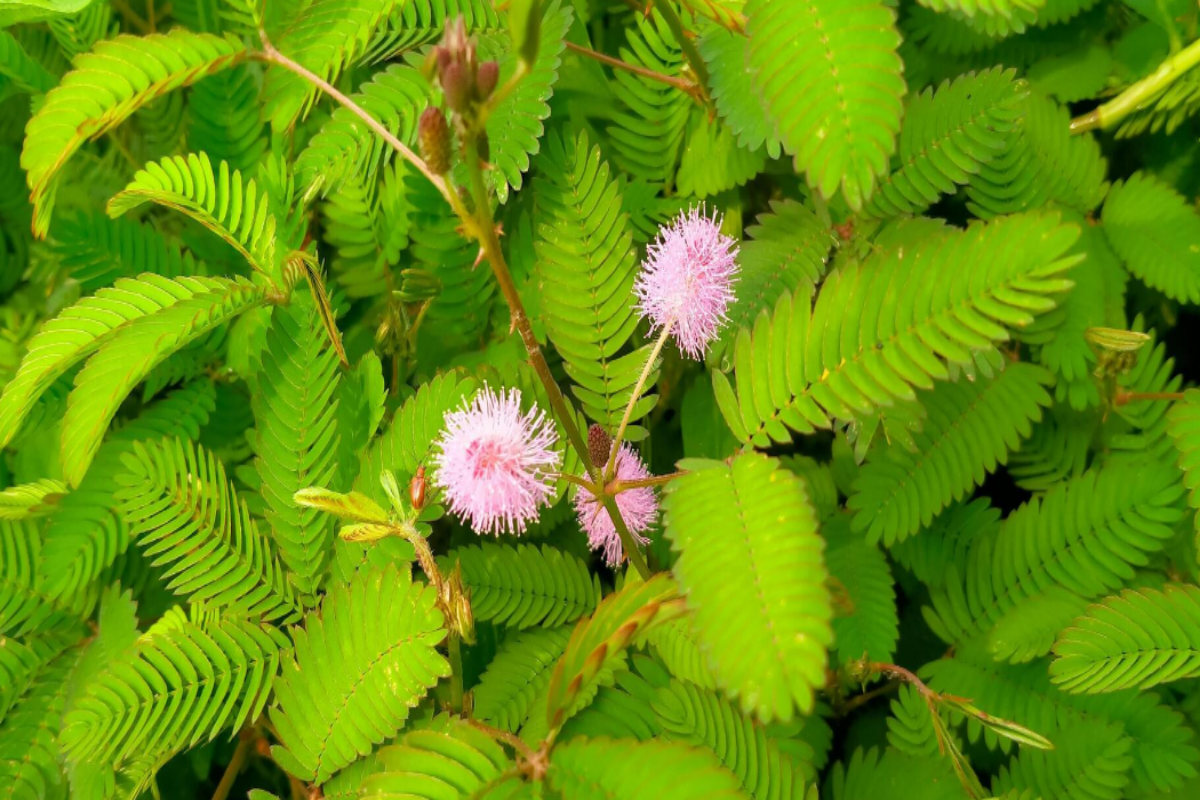
It is identified by its sparsely prickled stems, bipinnate leaves, and pink to lavender pompom-shaped flowers made up of thin petal strands.
Touch-Me-Not Plant Classification
- Domain: Eukaryota
- Kingdom: Plantae
- Phylum: Tracheophyta
- Subphylum: Angiospermae
- Class: Dicotyledonae
- Order: Fabales
- Family: Fabaceae
- Genus: Mimosa
- Species: Mimosa pudica
- Common Names: Humble Plant, Shameful Plant, Touch-and-Die, Live-and-Die, Sensible Plant, Action Plant, Sleepy Plant, and Sleepy Grass
Nativity and Distribution
Shameplant is native to Central and South America. Today, Mimosa pudica can be found in Australia, Micronesia, Asia, Africa, and the southern United States.
Physical Characteristics

- Leaves: Alternate, bipinnate with sensitive subdigitate pinnae
- Fruits: Clustered pods 1-2 cm long with bristled margins
- Stems: Slender, trailing or creeping, and can grow to 1m long
- Flowers: Globose to ovoid, pink to lavender in colour, and about 8-10 mm
- Roots: Tap root system
Shameplant is a creeping or sprawling herbaceous plant or sub-shrub from the legume family that typically grows to 50 cm and up to 100 cm if supported by other vegetation.
You can identify it by its prickled stems, bipinnate leaves, and pink pompom-shaped flowers made up of thin petal strands.
The stems are erect in seedlings but creep or trail as the plant matures. They are typically slender, branching, and have sparse prickles, about 2-2.5 mm long.
Mimosa pudica leaves are alternate, bipinnately compound, 1-5.5 cm long, with 5 oblong-shaped pinnae. Each pinna has 10-26 pairs of linear-oblong leaflets about 6-15 x 1-3 mm wide.
The leaves are extremely sensitive to stimuli. If slightly touched, blown, or shaken, the pinnae folds inwards and opens up later. The foliage also closes up at night and re-opens in the morning.
The inflorescence is pompom-shaped pink or lilac flowers held on stalk heads, 1 x 0.6-1 cm. A cluster borne on the leaf axil can bear 1-8 flower heads. The corolla is 2 mm long and contains four stamens. Touch-Me-Not flowers all year round.
The seed is pale brown, bristled, and 2.5 mm long.
Reproduction, Dispersal, and Life Cycle
- Life Cycle: Annual or long-lived perennial
- Seeds: A single plant can produce 700 seeds
- Climate: Thrives best in tropical and subtropical climates
- Dispersal: Animals and humans
Touch-Me-Not behaves as an annual or long-lived perennial depending on the prevailing environmental conditions. It reproduces by seeds. A single plant can produce 700 seeds.
The seeds are bristled, a feature that enables them to attach to bird feathers, animal fur, and human clothing for dispersal.
It grows in a range of soils, including low-nutrient and shallow soils. M.pudica prefers sunny areas but can also thrive in shade, in areas with high humidity and strong winds. It is intolerant of extreme shade and frost.
It is a common weed of pastures, hand-clutivated croplands, orchards, and plantations.
Similar Plants
- Mimosa pigra
- Mimosa diplotricha var. diplotricha
Uses
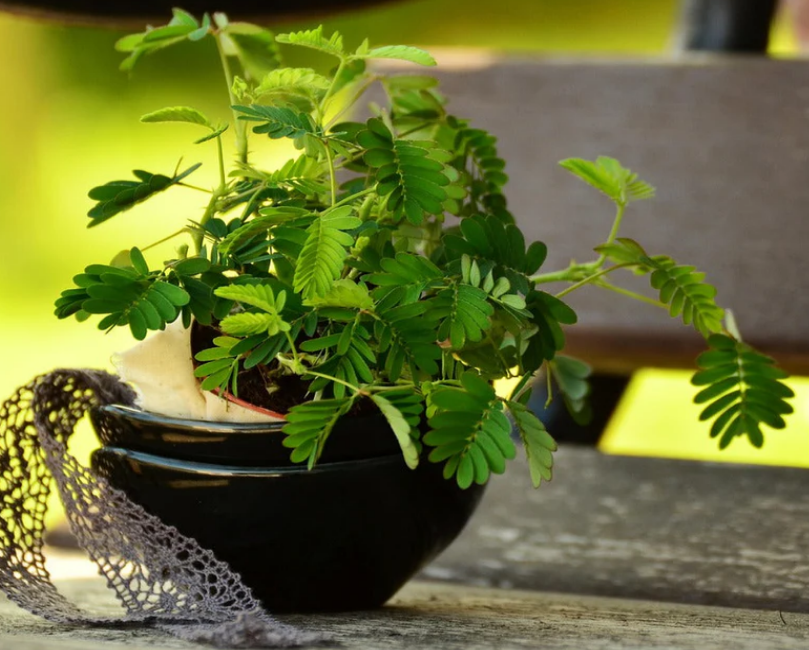
- It is grown as an ornamental house plant and in pollination gardens.
- The flowers are used to make distilled flower water.
- The seed can be pressed for oil similar to soybean oil.
- The roots are used as a traditional medicine for bilious fevers, piles, leprosy, jaundice, and piles.
- Leaf tonics are used to remedy drunkenness.
- It is planted as a cover crop in coconut plantations, green manure, and for soil erosion control.
- It has been used for phytoremediation in arsenic-polluted soils. It can also extract other heavy metals like tin, zinc, lead, and copper from polluted soils.
Impact on Farms and Environment
Mimosa pudica is a serious weed of crops like cotton, coffee, maize, coconuts, soybeans, and tomatoes. It particularly invades hand-cultivated fields.
Additionally, the weed can cause significant changes to the soil it invades. For instance, increased levels of potassium and nitrogen have been observed in highly infested areas.
Dry weed thickets can be a huge fire hazard. While it is used as forage in some countries, some varieties have been found to be poisonous to livestock.
Control
- Mechanical control: Handweeding or hoeing young plants
- Chemical control: Applying a postemergence herbicide like glyphosate
Handweeding and hoeing young plants can help remove small infestations, especially if done before they seed. Bigger plants have prickles that can cause injury, and hence, these methods may not be effective.
An application of a non-selective herbicide like glyphosate can help eradicate larger infestations. Ensure that you read the label first and follow all the instructions for effective control.

Lead Editor for Insight Weeds.