Stenotaphrum secundatum is a perennial mat-forming grass 10-30 cm tall. It reproduces by seeds and creeping stems and spreads by rhizomes and stolons.
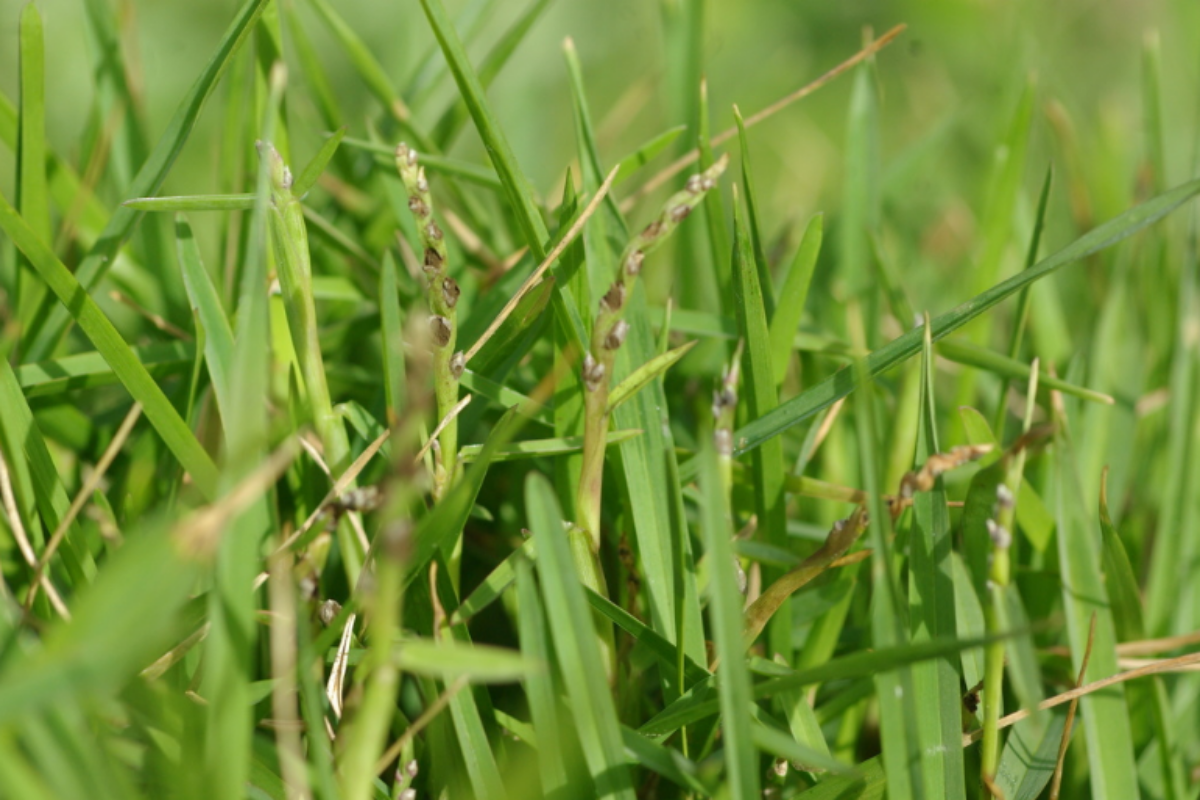
Buffalo grass is a popular turf grass valued for its hardy and lush green texture. It is identified by its dense and rich green foliage as well as its broad, conduplicate leaves.
Buffalo Grass Classification
- Domain: Eukaryota
- Kingdom: Plantae
- Phylum: Tracheophyta
- Subphylum: Angiospermae
- Class: Dicotyledonae
- Order: Cyperales
- Family: Poaceae
- Genus: Stenotaphrum
- Species: Stenotaphrum secundatum
- Varieties: Stenotaphrum secundatum. var secundatum
- Common Names: Buffalo Grass, St Augustine Grass, and Pemba Grass
Nativity and Distribution
Scotch grass is native to several tropical regions globally. They include tropical Africa (in countries such as Nigeria, Senegal, Cameroon, and Liberia), parts of the United States such as Florida and Texas, Central America, the Caribbean, South America, and Asia.
It has been introduced in other places such as Australia, Europe, New Zealand, Singapore, and parts of Africa and the United States.
Physical Characteristics
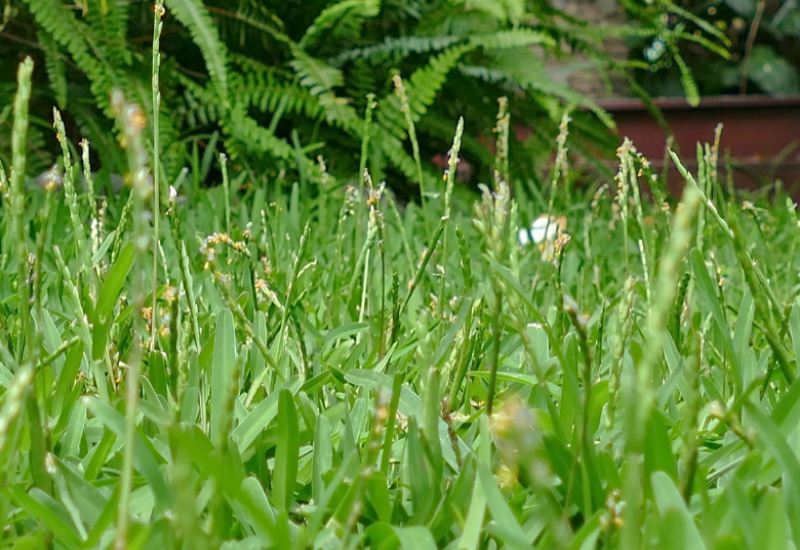
- Leaves: Alternate or paired, conduplicate leaves with an obtuse apex
- Stems: Prostrate and ascending culms
- Flowers: Hairless racemes with 1-3 spikelets
- Roots: Fibrous root system
Buffalo grass is a perennial mat-forming grass 10-30 cm tall. The rapidly spreading grass is a popular lawn grass loved for its dense, lush green growth. It is native to different tropical regions in the world, but there are several cultivars available that are adapted for use in other less favorable areas.
You can identify Stenotaphrum secundatum by its dark-green, broad leaves and lush, dense growth.
The leaves are broad, alternate or almost paired, conduplicate (folded lengthwise), about 2-15 cm long and 4-9 mm wide with entire margins.
They comprise a sheath, mostly hairless, about 3-6 cm long, although it may be slightly hairy at the joint where it meets the leaf blade. The blades are often folded when young and may be flat or still folded in maturity.
Para stems occur in two forms. The prostrate stems, 10-30 cm long, sprawl extensively on the ground, rooting at the nodes. Short ascending culms grow from the creeping stolons and are typically flattened and glabrous.
The stolon color varies based on the environment, shade, and age. The grass exposed to more sunlight bears purplish stolons while those under shade tend to have green stolons.
The grass bears racemes embedded in the axils, each bearing hairless, 4-6 mm long spikelets. Spikelets are oblong, falling entirely, deciduous, dorsally compressed, and about 5mm long.
The seeds are flattened on the back, elliptic to oblong, 4-5 mm long.
Reproduction, Dispersal, and Life Cycle
- Life Cycle: Perennial
- Seeds: Poor viable seed producer
- Climate: Tropical, subtropical, and temperate climates
- Dispersal: Limited water dispersal
S. secundatum behaves as a long-living perennial as the viable stolons progressively spread to far-reaching distances.
The grass has a low seed yield, making it an impractical strategy for propagation. Additionally, the seeds produced are locally dispersed by floating on water for a limited period between 7 and 10 days. That said, some cultivars, such as Seville and Palmetto, have good viable seed yield.
Improper disposal of stolons and seed material can also contribute to dispersal, leading to new growth and colonization of new areas.
Buffalo grass is a highly commercialized grass and is mainly propagated vegetatively. Many cultivars of the grass are available across the globe. Some of the well-known names include Raleigh, Palmetto, and Sir Walter buffalo grass.
Similar Plants
- Cenchrus clandestinus
- Axonopus spp.
- Eremochloa ophiuroides
Uses

- Buffalo grass is a popular warm-season landscaping grass, grown for high salt and shade tolerance, and dense carpet growth.
- Some cultivars are grown as forage for ruminants because of their easy establishment and heavy grazing tolerance.
- It is used as ground cover for soil conservation in areas near water bodies.
Impact on Farms and Environment
S. secundatum is a hardy and dense turf, popular in residential and other landscaping settings. Due to its rapid growth, especially in warmer weather, it can easily escape to unwanted areas, becoming an aggressive weed in the environment.
In Australia and New Zealand, it is considered an environmental weed, commonly found in swamps, lawns, gardens, coastal areas, and other disturbed sites. Where required, the grass can grow tall, smothering smaller shrubs and negatively impacting landscaping or native biodiversity.
Airborne pollen from the grass is also reported to cause allergic reactions to humans in Cape Province, South Africa, especially during prolonged dry and windy summers.
Control
- Mechanical control: Solarization or hand-pulling the trailing stems at the edge of infestations
- Chemical control: Herbicides like haloxyfop, glyphosate, or 2,4-D.
Kakadu is considered a beneficial grass globally. However, when it turns weedy, there are expert-recommended measures you can take.
Solarization, a plastic sheet covering the grass for 6-12 weeks, can provide effective control against unwanted growth. Alternatively, pull the stems, starting from the edges of the paths or lawns, and dispose of the fragments properly.
For larger infestations, consider selective or non-selective herbicides like haloxyfop, glyphosate, and 2,4-D, depending on the infested area.

Lead Editor for Insight Weeds.