Tropical grasses are a common sight in many tropical and subtropical climates around the globe.
Apart from the known landscaping uses, the also play an important role in agriculture and the stability of numerous ecosystems.
That said, distinguishing between the grasses can prove difficult for landscapers and farmers looking to plant or eradicate them.
In this post, we’ll explore different tropical grasses, their common names, distinct physical features, and pictures to help you learn more about them and for easier identification.
1. Carpet Grass (Axonopus Compressus)

- Scientific Name: Axonopus Compressus
- English Name: Blanket Grass
- Annual or Perennial: Perennial
- Grass, Sedge, or Broadleaf: Grass
Carpet Grass is a perennial stoloniferous grass that can reach 15 cm in height. It thrives in full sun or partial shade and wet to acidic soils.
The leaves are opposite, oblong, smooth on both surfaces, and about 4-15cm long. Its unique stem culms are shallow-rooted and grow close to the ground, giving it a lush mat-formation.
This native American grass is commonly used as pasture or turf grass for its grazing tolerance and low-maintenance needs.
2. Elephant Grass (Pennisetum purpureum)

- Scientific Name: Pennisetum purpureum
- English Name: Napier Grass
- Annual or Perennial: Perennial
- Grass, Sedge, or Broadleaf: Grass
Pennisetum purpureum is a vigorous grass that achieves an impressive height of 3-5m. It has broad, flat, and long leaves measuring 2 meters, robust stems that are covered with fine hairs, and well-developed roots.
Elephant Grass, also called Napier Grass, is one of the most versatile and high-yielding tropical grasses. It thrives in a variety of extreme conditions, including dry and wet environments, which can also make it an invasive weed in many ecosystems.
Elephant grass is mainly grown for livestock feed, especially in cut-and-carry systems, due to its high biomass yield, for erosion control, and biofuel production.
3. Buffalo Grass (Paspalum conjugatum)

- Scientific Name: Paspalum conjugatum
- English Name: Carabao Grass
- Annual or Perennial: Perennial
- Grass, Sedge, or Broadleaf: Grass
Buffalo Grass is a tropical perennial grass that is native to tropical and subtropical Americas. It produces short culms about 60 cm high, short and soft-textured leaves with a distinct midrib.
Buffalo Grass reproduces by seeds and vegetative means, making it a high-yielding turf. It can tolerate waterlogging and shade, and is commonly found in pastures, open areas, vineyards, irrigation channels, and forest clearings.
The grass is popular in landscaping due to its high mowing and traffic tolerance. It is also grown for fodder in cut-and-carry systems, as ground cover in shaded areas, and for weed control.
4. Bermuda Grass (Cynodon dactylon)

- Scientific Name: Cynodon dactylon
- English Name: Couch Grass
- Annual or Perennial: Perennial
- Grass, Sedge, or Broadleaf: Grass
Bermuda Grass is a rapidly growing tropical grass that springs up in the warmer seasons. The African native grass has unique green to dark-green, bladelike leaves that can grow up to 5 cm long.
You can also recognize its flattened, purplish, slightly hairy stems and deep rhizomes that typically penetrate 40-50 cm into the soil. It thrives in full sun, is drought-tolerant, and can also withstand high traffic.
For these reasons, it is a popular turf grass in residential areas, golf courses, and gardens. It is also used in soil erosion control and as feed for livestock.
5. Kikuyu Grass (Cenchrus clandestinus)
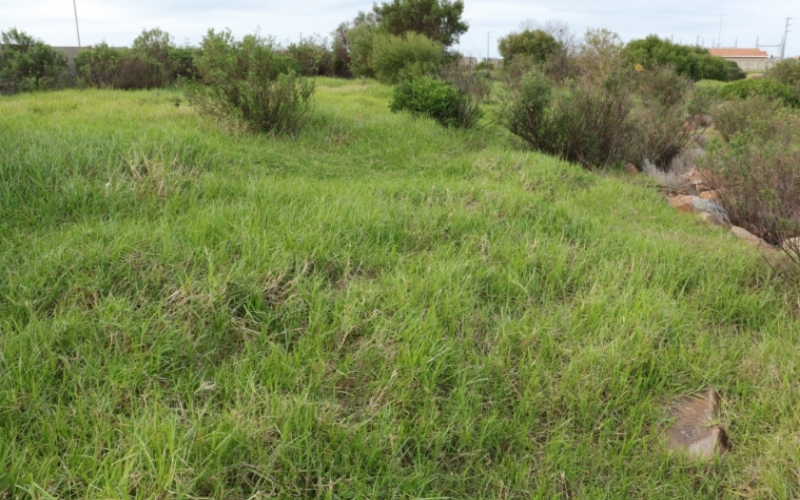
- Scientific Name: Cenchrus clandestinus
- English Name: Kikuyu Grass
- Annual or Perennial: Perennial
- Grass, Sedge, or Broadleaf: Grass
Kikuyu Grass, previously classified as Pennisetum clandestinum, is a perennial tropical grass native to East Africa, and can be identified by its flattened, coarsely-textured leaves, heavily branched stolons, and dense foliage.
It thrives in sunny and warm climates and rapidly grows through rhizomes and stolons. Kikuyu Grass is a valuable pasture grass due to its high grazing tolerance and is a common turfgrass for residential lawns and golf courses.
However, it is also an invasive weed in many regions globally, especially because of its high seed dormancy and rapid growth. It can climb, shade, or release toxins that inhibit the growth of other plant species.
6. Para Grass (Urochloa mutica)

- Scientific Name: Urochloa mutica
- English Name: Scotch Grass
- Annual or Perennial: Perennial
- Grass, Sedge, or Broadleaf: Grass
Para Grass is a creeping, fast-growing, semi-aquatic perennial grass that grows 2-5m tall. It is native to parts of the Middle East and Central Africa.
The leaf blades are broad, sparsely or densely haired, and about 30 cm long. Stems are hairy and semi-prostrate and have distinct swollen nodes as well as green to purplish glumes.
Scotch Grass mainly propagates by creeping stems that produce shoots and roots, spreading several meters along the ground.
It is commonly grown as fodder for livestock, for soil erosion control, land reclamation, and as an ornamental grass for its lush appearance.
7. Buffel Grass (Cenchrus ciliaris)
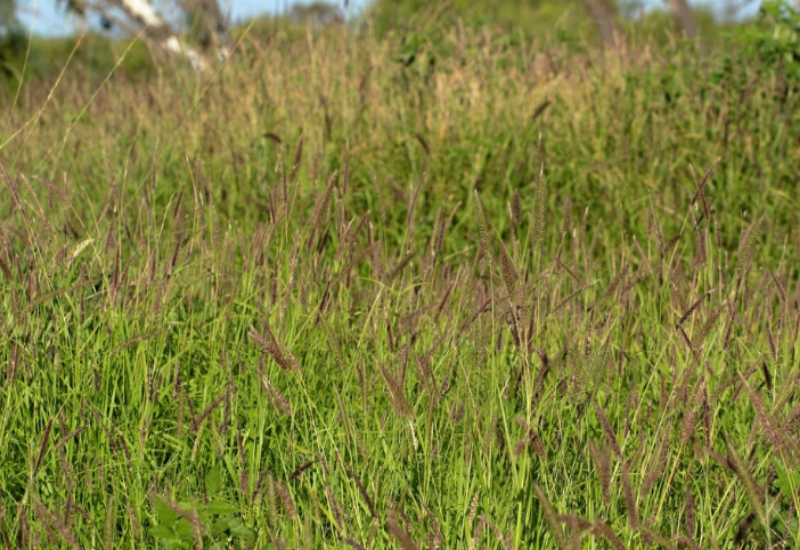
- Scientific Name: Cenchrus ciliaris
- English Name: Foxtail Buffalo Grass
- Annual or Perennial: Perennial
- Grass, Sedge, or Broadleaf: Grass
Buffel Grass is a tussock-forming, perennial grass, native to tropical Africa, the Mediterranean, and Southern Asia. It produces erect or decumbent culms that can reach up to 2m tall. The leaves are linear, bluish-green, about 3-30 cm long.
C. ciliaris also bears spike-like panicles 2-14 cm long, comprising spikelets surrounded by hairy bristles. It thrives in arid and semi-arid areas and will commonly be located in grasslands and open areas.
Buffel Grass is a highly valued pasture and forage grass in the tropics. It is also used for land reclamation and soil erosion control.
Due to its deep root system (a rootstock that can penetrate 2m in the soil), the grass can spread extensively and outcompete native grasses. It has been declared a noxious weed in countries like Australia, the USA, and Mexico.
8. Signal Grass (Brachiaria decumbens)

- Scientific Name: Brachiaria decumbens or Urochloa decumbens
- English Name: Signal Grass/Kenya Sheep Grass
- Annual or Perennial: Perennial
- Grass, Sedge, or Broadleaf: Grass
Signal Grass is a perennial tropical grass native to the Eastern and Central African highlands. It can be decumbent or erect, growing up to 60cm tall.
The leaves are short, soft, and bright green, with bent tips. Stems give rise to rhizomes and stolons, which can root down as deep as 2m in the deep soil. It thrives in all soil types except heavy clay soils and can tolerate shade.
The grass is mainly grown as a permanent pasture for beef grazing or fodder in cut-and-carry systems due to its high palatability and heavy grazing tolerance. Additionally, Signal Grass can also be used in soil erosion control efforts and weed suppression.
- Guinea Grass (Megathyrsus maximus)
9. Guinea Grass (Megathyrsus maximus)
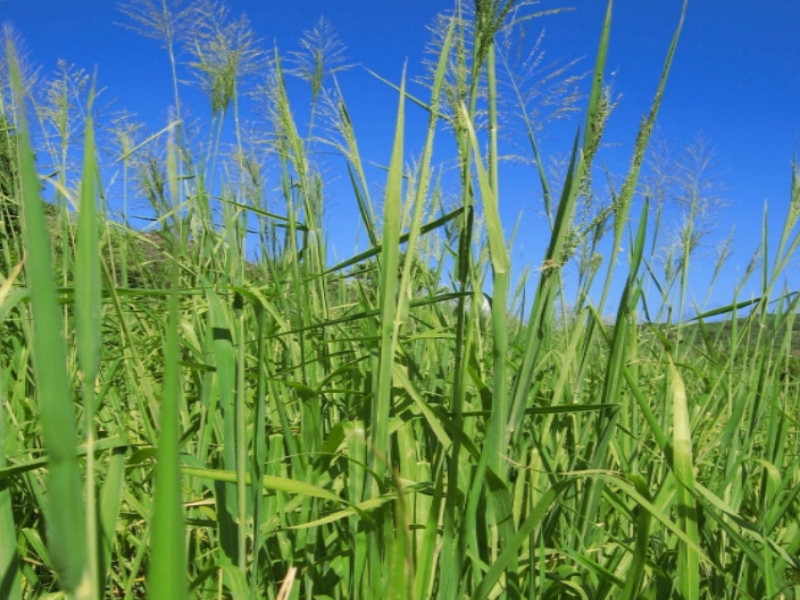
- Scientific Name: Megathyrsus maximus
- English Name: Guinea Grass/Tanganyika Grass
- Annual or Perennial: Perennial
- Grass, Sedge, or Broadleaf: Grass
Guinea Grass is a large tufted grass that can grow between 50 and 350 cm tall, depending on the prevailing conditions. It is native to tropical Africa and Yemen.
M. maximus produces blade-shaped leaves that can be up to 100 cm long, cylindrical, erect culms, a panicle 15-50 cm long with green to purple spikelets, and a short creeping rootstock.
The fast-growing grass is mainly grown for pasture, silage, and hay and is also used for soil erosion control.
Due to its rapid growth and space uptake, it can become weedy in some regions, outcompeting native plant species in grasslands and woodlands. It is also considered a fire hazard in wildfire-prone areas globally.
10. BahiaGrass (Paspalum notatum)

- Scientific Name: Paspalum notatum
- English Name: Bahiagrass/Common Bahia
- Annual or Perennial: Perennial
- Grass, Sedge, or Broadleaf: Grass
Bahiagrass is a perennial warm-season grass, native to Mexico and South America. You can identify it by its flat, light-green, coarse-textured foliage and V-shaped inflorescence, comprising two racemes.
It also produces low-growing stolons that are pressed to the ground and root at the internodes, forming dense mats. The stems can grow between 20 and 70 cm tall.
P. notatum thrives in sandy loam soils and full sun but can tolerate shade, saline conditions, and drought. It is primarily established as forage for grazing animals and soil erosion control.

Lead Editor for Insight Weeds.