Euphorbia hirta is a herbaceous annual plant, prostrate or erect to a height of 60 cm. It propagates by seed and is a common weed of lawns, roadsides, and agricultural areas.
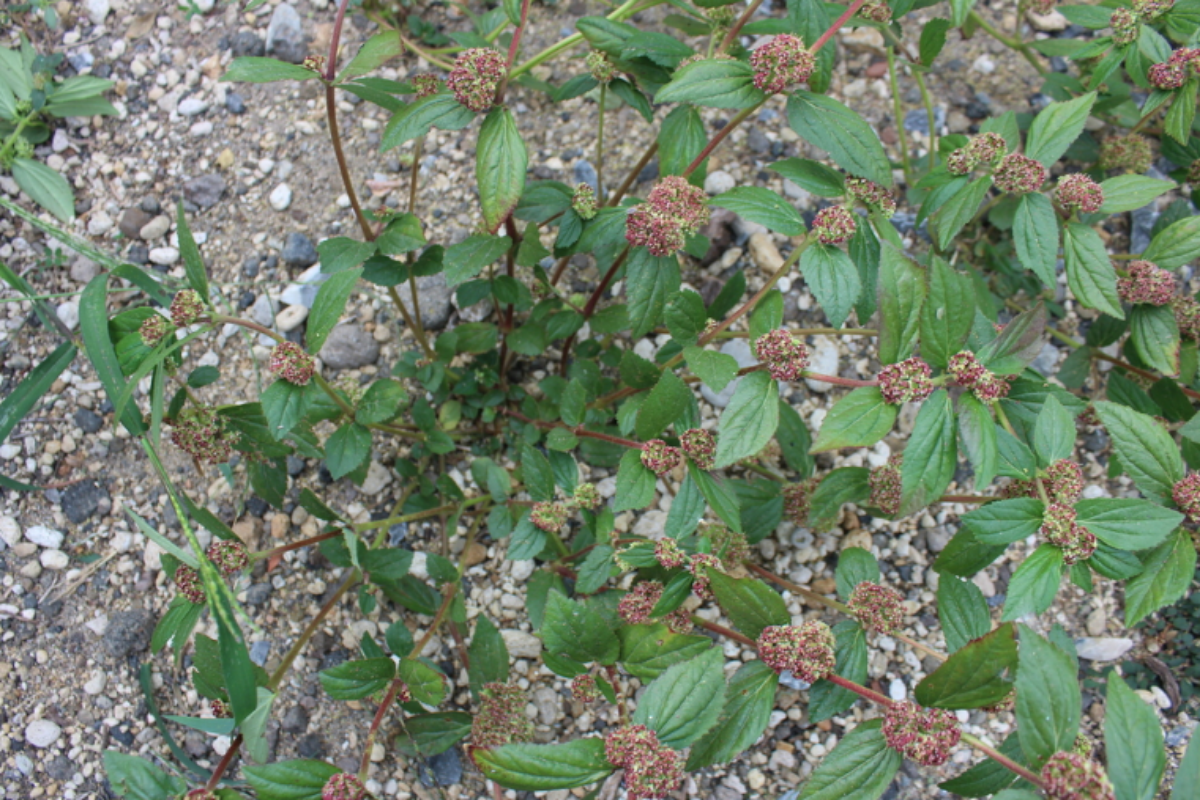
It is easily identified by its reddish-purple stems, oblong to lanceolate green leaves with reddish-purple spots, and dense balls of flowers and fruit capsules.
Asthma Plant Classification
- Domain: Eukaryota
- Kingdom: Plantae
- Phylum: Tracheophyta
- Subphylum: Angiospermae
- Class: Dicotyledonae
- Order: Malpighiales
- Family: Euphorbiaceae
- Genus: Euphorbia
- Species: Euphorbia hirta
- Common Names: Asthma Weed, Dove Milk, Sneeze Weed, Red Euphorbia, Spurge, Garden Spurge, and Hairy Spurge
Nativity and Distribution
The Asthma Plant originates from the tropical and subtropical Americas but has since spread to Australia, Africa, Southeast Asia, and the Pacific Islands.
Physical Characteristics
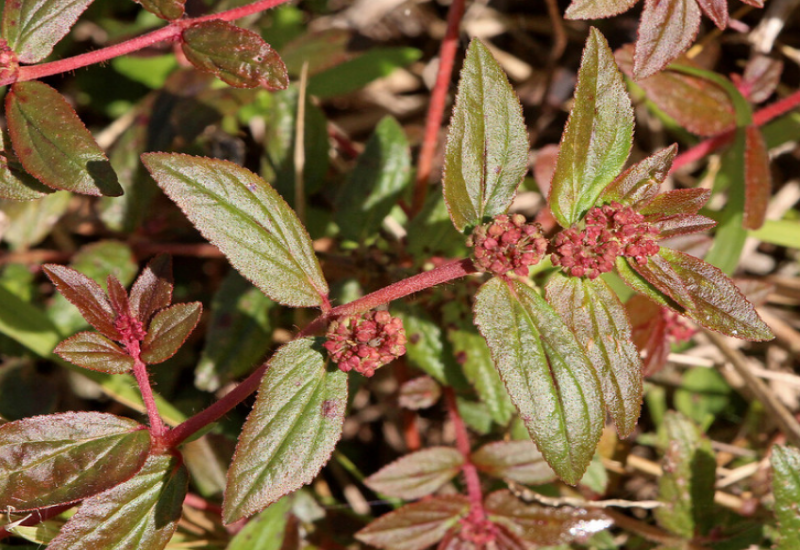
- Leaves: Oblong to lanceolate, green leaves with reddish hues
- Fruits: Hairy, 2 x 1.5 mm, 3-sided capsule
- Stems: Prostrate to ascending, reddish-purplish stems with yellowish hairs
- Flowers: Green, to brown to pink, ball clusters occurring in the leaf axils
- Roots: Taproot system
E. hirta is a warm-season herbaceous annual that can grow up to 60 cm tall. You can identify it by its reddish-purple stems, oblong to lanceolate green leaves with reddish-purple spots, and dense balls of flowers and fruit capsules.
The leaves are green, oblong to lanceolate in shape, with an oblique base, serrated margins, and a pointed tip. They measure about 1 x 3 cm, have reddish spots, and are hairy on both surfaces, but particularly more hairy on the lower surface veins.
Stems are round, prostrate to ascending, reddish-purple, covered with yellowish coarse hairs, hence the Latin name, hirta, which means hairy. They arise from a central taproot (that can grow between 4-24 inches long), measure about 15-50 cm long, and produce abundant milky white latex sap when broken.
The Asthma Plant produces green, brown, to pink, ball-shaped clusters of tiny flowers with no petals, about 5-10 mm wide, occurring in the leaf axils. Reduced bracts occur under the cyathia.
The seed is oblong, four-sided, orange to brown, and about 0.7-0.9 mm.
Reproduction, Dispersal, and Life Cycle
- Life Cycle: Annual
- Seeds: A single plant can produce 3,000 seeds
- Climate: Tropical and subtropical climates
- Dispersal: Wind and water
Euphorbia hirta behaves as an annual, thriving in tropical and subtropical climates. It reproduces by seed, with one plant producing thousands of seeds in one growing season.
The fruit, upon maturity, dries and dehisces to release the seeds. They are further dispersed by wind and water and germination begins immediately as they don’t have a dormancy period.
Asthma Weed prefers well-drained soil but can grow in a variety of soils, including poor soils, and can tolerate full shade or full sun. However, it is intolerant to frost.
It is a common weed of roadsides, lawns, container nurseries, and agricultural areas.
Similar Plants
- Euphorbia maculata
- Euphorbia thymifolia
- Euphorbia hyssopifolia
Uses
- It is used as a ground cover or bed cover.
- The stem provides an important herbal medicinal for treating respiratory issues like asthma and bronchitis, gastrointestinal disorders, and skin ailments.
- The plant is consumed as a herbal tea to treat malaria and dengue.
- Young shoots and leaves are cooked as a vegetable during famine.
- The plant is used as an antidote for snake bites and scorpion stings.
- The sap is used to treat fungal infections between the toes and to facilitate the removal of thorns on the skin.
Impact on Farms and Environment
E. hirta is a common weed in agricultural settings and can affect a variety of crops depending on the host country. For instance, it is a weed of cotton in Mozambique, Kenya, and El Salvador, and can also be found in Maize farms in India, Thailand, Mexico, and Ghana.
Due to its high seed production and rapid growth, the Asthma Plant can become weedy and competitive, leading to poor crop yields. It is also a known host of destructive fungal pathogens, arthropods, and nematode pests, which can cause disease and rot in farm crops, leading to further losses.
Control management practices to eradicate the weed can increase farming costs, especially where large infestations occur.
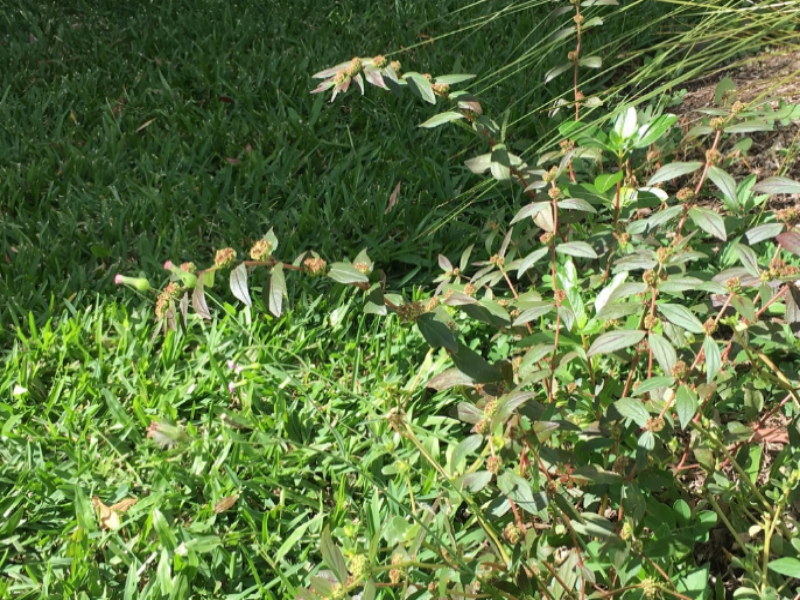
In landscaped areas, it can compete with thin turfgrass, making it vulnerable to other weed invasions. It also reduces the aesthetic value of grass.
As with many of the euphorbia family, Garden Spurge stems contain milky sap that can cause severe skin irritation and inflammation. The latex toxicity remains high even in dried plant material. It is also highly toxic to pets or children if ingested.
Control
- Mechanical control: Hand-pulling, hoeing, and mulching
- Chemical control: Apply postemergence and follow up with preemergence herbicides
Asthma plant is easy to remove by hand-pulling (every 2-4 weeks) or hoeing, as it does not root at the nodes. However, ensure that you wear protective gloves as you handle the plant.
Mulching is an effective control method for preventing seedling growth in landscapes and nurseries, as the seeds require light for growth. A 2-3 inch layer of mulch materials that dry quickly, such as pine bark, rice hulls, or pine straw, is recommended.
Depending on the area or crop infested, you can apply most of the postemergence herbicides available, such as glufosinate or diquat, for effective eradication. For larger infestations, a systemic herbicide like glyphosate can provide effective control.
After postemergence treatment, preemergence herbicide treatments are necessary, especially on landscape beds, to prevent regrowth. Some of the most effective active ingredients include flumioxazin and indaziflam.

Lead Editor for Insight Weeds.