Ajuga is a genus of low-growing, herbaceous evergreen to semi-evergreen perennials in the mint family, Lamiaceae, that grow 10-30 cm tall. It is native to Northern Africa, southwestern Asia, and Europe.
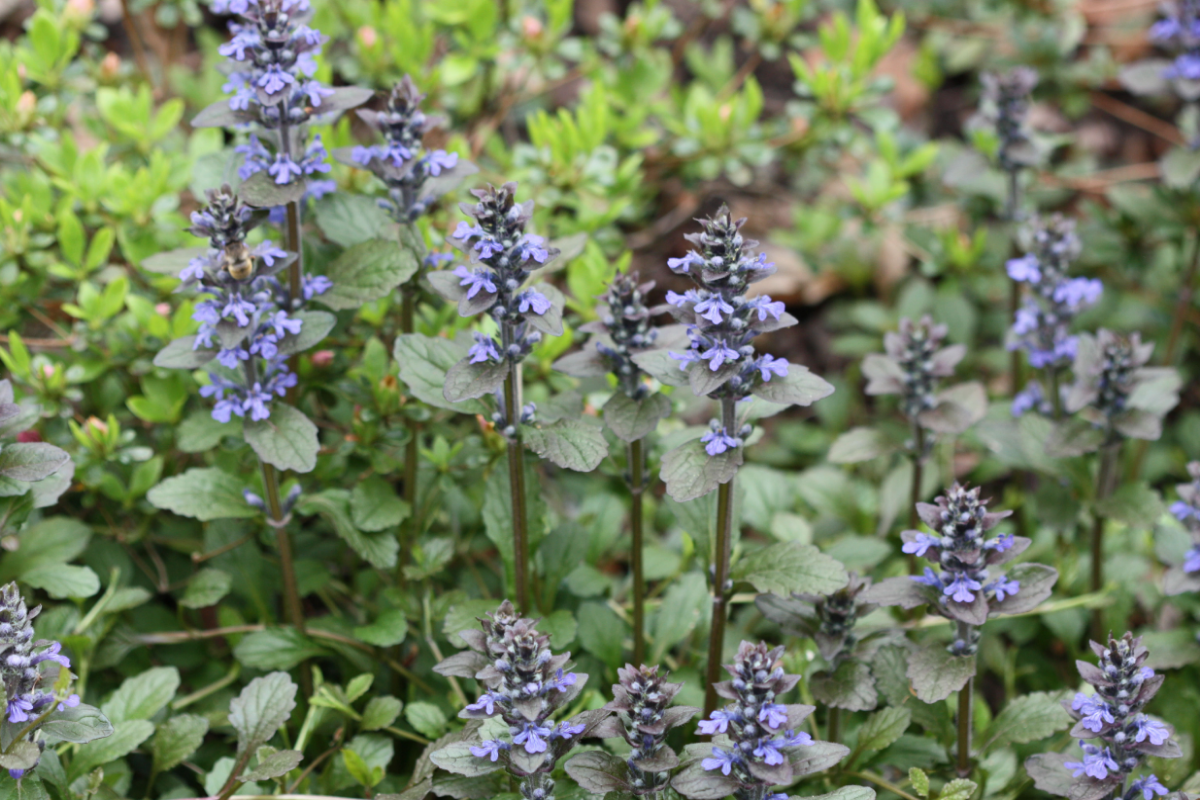
Many species can be identified by their glossy, oval-shaped leaves in tight rosettes with green, purple, silver, or bronze colour or variegated in green, white, or yellow and showy, upright whorled spikes of two-lipped, tubular blue-violet flowers.
Bugleweed Classification
- Domain: Eukaryota
- Kingdom: Plantae
- Phylum: Tracheophyta
- Subphylum: Angiospermae
- Class: Magnoliaspida
- Order: Lamiales
- Family: Lamiaceae
- Genus: Ajuga
- Species: Approximately 40-50 species, such as Ajuga reptans, Ajuga orientalis, Ajuga genevensis, Ajuga pyrmidalis, and Ajuga bracteosa
- Common Names: Bugle, Carpet Bugle, Blue Bugle, Common Bugle, Carpet Bugleweed, Carpetweed, and Buglewood
Nativity and Distribution
Bugleweed is native to Northern Africa, southwestern Asia, and Europe. Through the horticultural industry, the species has been introduced to other parts of the world, including Australia, New Zealand, and North America.
Physical Characteristics
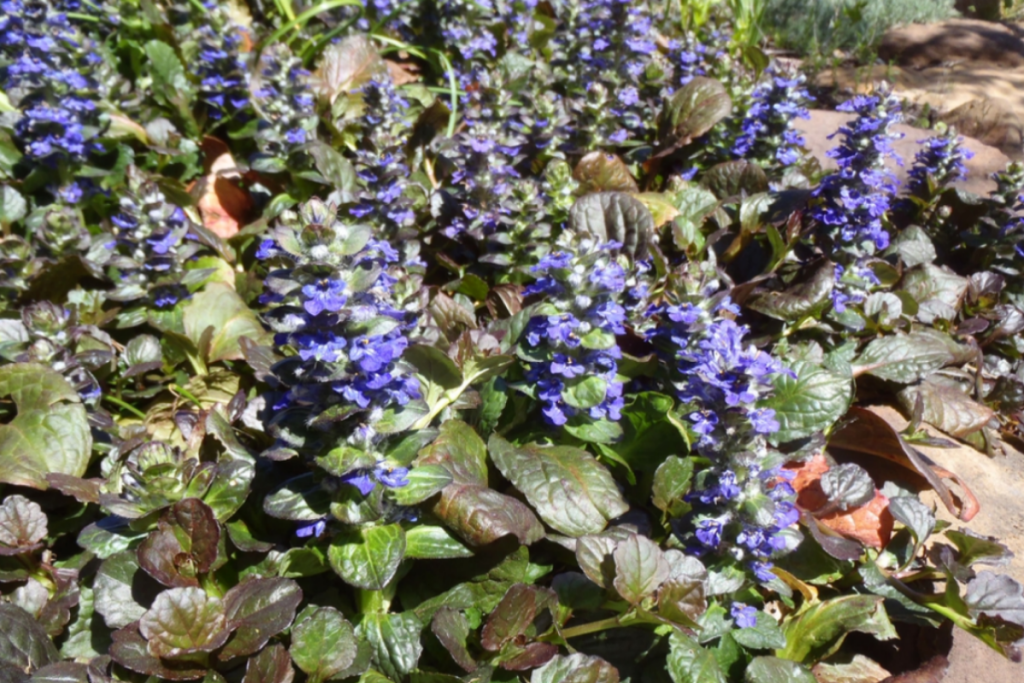
- Leaves: Opposite, oval, glossy with various colours and variegated shades
- Fruits: Small, oval-shaped, dry nutlet with a pitted surface
- Stems: Square, stoloniferous, slightly pubescent or hairy
- Flowers: Two-lipped, tubular, occurring in whorled spikes
- Roots: Fibrous root system
Ajuga is a genus of low-growing, herbaceous evergreen to semi-evergreen perennials that grow 10-30 cm tall. Species can be identified by their glossy, oval-shaped leaves in tight rosettes with green, purple, silver, bronze colour or variegated in different colours and showy, upright whorled spikes of two-lipped, tubular blue-violet flowers.
Stems are square in cross-section, stoloniferous and rhizomatous, rapidly spreading along the soil surface to form dense, carpet-like mats. In the bloom season, vertical flowering stems emerge above the foliage.
Bugleweed leaves are glossy, oval to spatula-shaped, forming dense basal rosettes. Depending on the specific cultivar, the foliage can be green, purple, bronze, or silver and variegated in white, cream, pink, red, or yellow.
Basal leaves are obovate to elliptical with wavy edges, about 7 cm long and 2 cm wide, while the leaves along the stalk are opposite, ovate, and smaller in size. The foliage remains evergreen, providing a colorful groundcover throughout the year.
Flowers are two-lipped and tubular, borne on dense vertical spikes about 15 cm long. They can be blue-violet, blue, pink, purple, or white in colour. Flowering occurs in spring to early summer in many regions.
Reproduction, Dispersal, and Life Cycle
- Life Cycle: Perennial
- Seeds: A single plant can produce hundreds of seeds per growing season
- Climate: Thrives best in temperate and cool subtropical climates
- Dispersal: Falling, vegetative, animal, and human activity
Bugleweed behaves as a hardy perennial with established colonies persisting for many years where suitable conditions prevail. The plant reproduces through vegetative and seed production.
The seeds are found within dry nutlets and typically fall beneath the parent plant to begin germination. Small animals, birds, and insects may transport the seeds attached to feathers and fur to new areas. Human activity through nursery production and landscape cuttings has also contributed to the introduction of the plant in different regions globally.
While the species and cultivars in the Ajuga genus may produce seeds regularly, the primary means of propagation is through vegetative growth, where stolons that root at the nodes to produce new plants.
The plants prefer moist soil, full sun, and deep shade. They can tolerate partial shade and can tolerate seasonal drought once established.
Similar Plants
- Lamium maculatum
- Glechoma hederecea
- Prunella vulgaris
- Veronica peduncularis
Uses
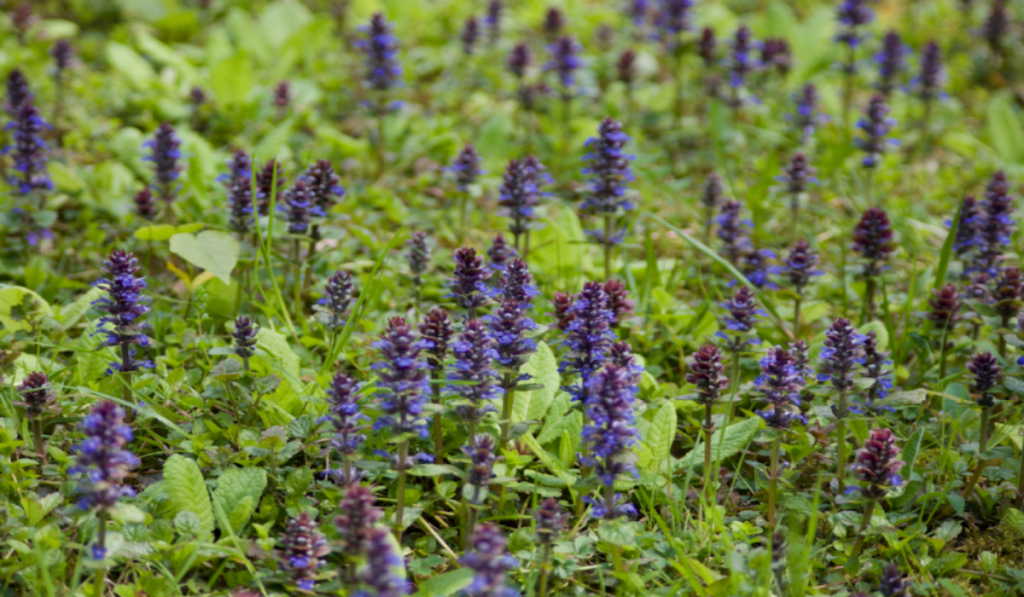
- It is grown as a groundcover plant for shady and partially-shaded landscapes.
- Ajuga is a popular plant in rock, woodland, and pollinator gardens for its beautiful foliage, as it is a favorite of hummingbirds, bees, songbirds, and moths.
- Bugleweed is also grown as a border plant along paths and garden beds.
- The plant is also grown on slopes and steep banks to prevent erosion.
- Common Bugleweed was used as traditional medicine in European folklore to improve hyperpigmentation, skin hydration, and to prevent alopecia.
Impact on Farms and Environment
Bugleweed is a beneficial ground cover plant that can also prevent soil erosion in various settings. It is also not considered a significant agricultural weed.
However, some species can escape and spread aggressively in favorable conditions. These new populations may suppress other plants in nurseries and ornamental landscapes, crop lands, and pastures.
Constant monitoring and early intervention is required to keep escaped populations from establishing in unwanted areas.
Control
- Mechanical control: Hand-pulling, digging, and mulching
- Cultural control: Edge trimming and monitoring
- Chemical control: Treatment with a non-selective herbicide like glyphosate
For small infestations, hand-pulling or lifting the mats and digging the runners is a viable option in achieving effective control over Bugleweed. Repeat pulling of new plants is required in the next few seasons to prevent reestablishment.
In ornamental beds, applying a thick layer of mulch can suppress new stolons and the establishment of seedlings. Edge trimming and routine pruning of runners can help contain the spread in the desired areas.
Where pulling or mulching is impractical, repeat spot treatments of a non-selective herbicide like glyphosate or a post-emergent herbicide combination like 2,4-D +Dicamba + MCPP or Triclopyr can help eradicate established colonies.
Read the product label and strictly follow the usage instructions as directed for the best results.

Lead Editor for Insight Weeds.