Daucus carota is a biennial wildflower in the Apiaceae family that grows 30-120 cm tall with a spread of 30-60 cm. It is native to Europe, North Africa, and Southwest Asia and is commonly found in open fields, on roadsides, and in waste areas.
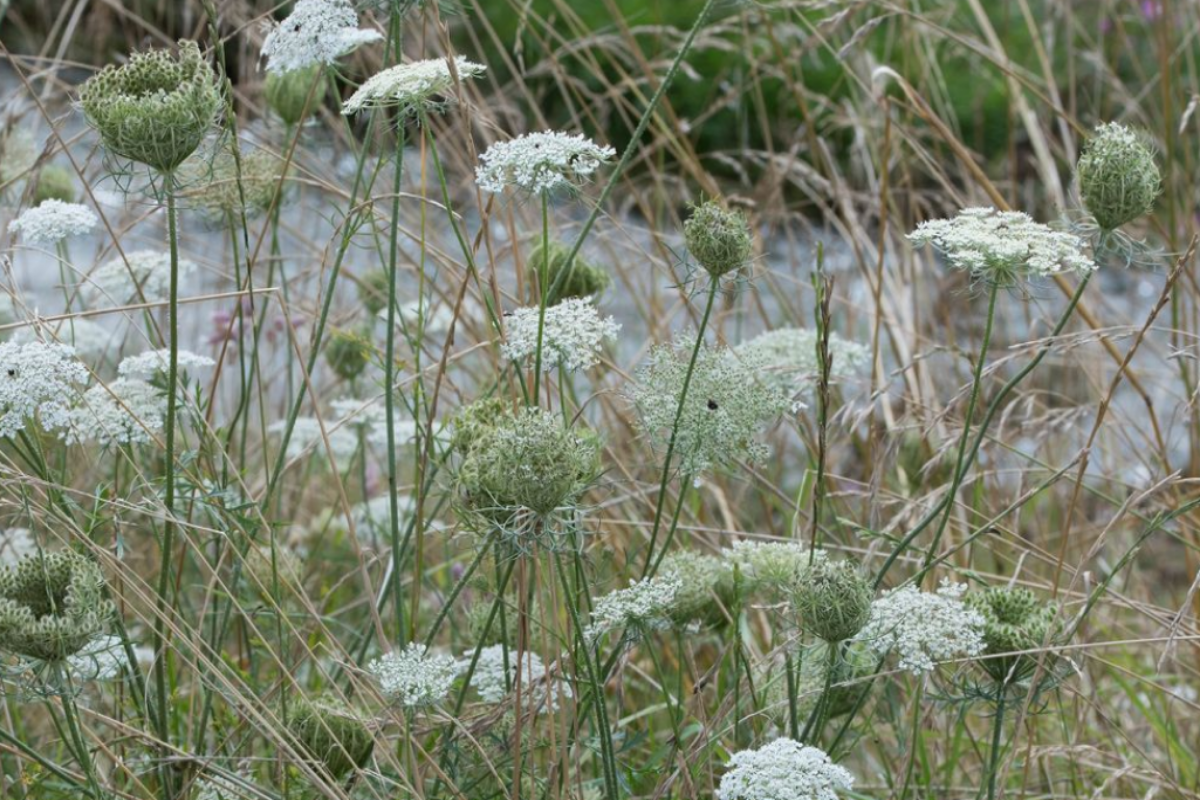
It is easily recognized by its hairy stems, finely divided, fern-like foliage, and umbrella-shaped clusters of small, white flowers.
Wild Carrot Classification
- Domain: Eukaryota
- Kingdom: Plantae
- Phylum: Tracheophyta
- Subphylum: Angiospermae
- Class: Magnoliaspida
- Order: Apiales
- Family: Apiaceae
- Genus: Daucus
- Species: Daucus carota
- Common Names: Queen Anne’s Lace, Bishop’s Lace, Bird’s Nest, Bee’s Nest Plant, Devil’s Plague, and Lace Flower
Nativity and Distribution
Queen Anne’s Lace is native to Europe, North Africa, and Southwestern Asia. As one of the most widespread species in the carrot family, it is also currently found in:
- Australia
- New Zealand
- Southern Africa
- Parts of Eastern Asia
- The Americas
Physical Characteristics
- Leaves: Alternate, feathery, 2-pinnately divided, fern-like, and about 10-30 cm long
- Fruits: Small, dry, brown, oval to oblong capsule with hooked bristles, and 3-5 mm long
- Stems: Upright, ridged, hairy, branched on the upper parts
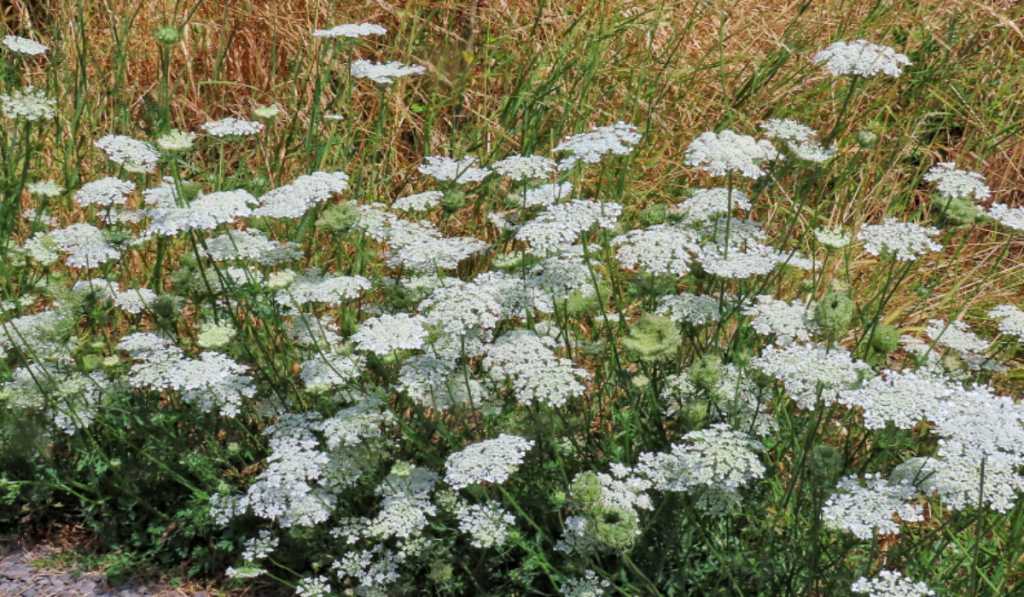
- Flowers: Small clusters of white flowers arranged on large, compound umbels
- Roots: Taproot system
Daucus carota is a biennial wildflower in the Apiaceae family that grows 30-120 cm tall with a spread of 30-60 cm. You can easily recognize the species by its hairy stems, finely divided, fern-like foliage, and umbrella-shaped clusters of small, white flowers.
Stems are upright, green, longitudinally ridged, and densely covered with coarse hairs. The coarse hairs distinguish Daucus carota from other look-alikes that have smooth stems. They are typically hollow and can reach up to 1.2m in height.
The leaves are alternate, feathery, 2-pinnately divided, with a triangular outline, giving them a fern-like appearance. The basal leaves are larger, about 10-30 cm long, while the upper leaves become progressively smaller towards the top of the stem. Both leaf surfaces are hairy and emit a carrot smell when crushed, hence the name “Wild Carrot”.
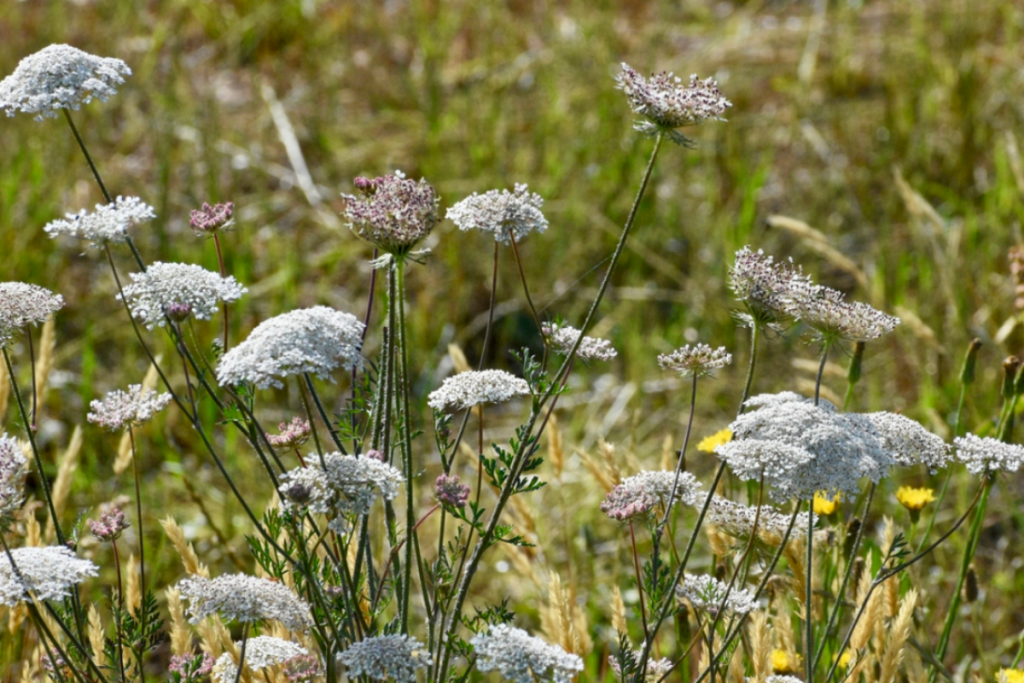
Wild Carrot produces tiny, white flowers typically with a dark purple center. The flowers are arranged in large, flat-topped, lacy compound umbels, measuring 5-13 cm wide. After the seed development, the umbels coil inwards, forming a shape similar to a bird’s nest.
The seed is compressed, dry, grey to greyish-brown in colour, about 2.5-4 mm long, and covered with numerous hooked bristles.
Reproduction, Dispersal, and Life Cycle Physical Characteristics
- Life Cycle: Biennial
- Seeds: A single plant can produce 1,000 – 40,000 seeds
- Climate: Thrives best in temperate climates
- Dispersal: Animal, wind, and human activity
Wild Carrot behaves as a biennial, producing the basal leaves and storing energy in the taproot in the first year. In the second year, it sends up the flowering stem, sets seed, and dies after reproduction.
The seeds first fall beneath the parent plant, and germination occurs in autumn or spring under favourable temperature and moisture conditions.
Most seeds are dispersed by animals and birds as the seeds readily attach to fur and feathers. This enables the transportation of the seeds to even longer distances.
The dry seeds may also roll to further distances, facilitated by strong winds or spread through contaminated seed, hay, or machinery, road maintenance, soil movement, and ornamental plantings.
Seeds that go beneath the topsoil can remain viable for several years.
Daucus carota thrives in temperate climates, in full sun to partial shade, and in well-drained loamy or sandy soils. It can tolerate dry to moderately moist soil and drought once established.
Queen Anne’s Lace is commonly found in open fields, roadsides, abandoned fields, meadows, grasslands, pastures, and waste areas.
Similar Plants
- Conium maculatum
- Heracleum sphondylium
- Aethusa cynapium
- Aegopodium podagraria
- Anthriscus sylvestris
Uses
- The plant’s roots are consumed like domesticated carrots, raw or as cooked vegetables. They are also ground into powder and consumed as a coffee drink.
- The flowers and aromatic seeds are used to flavor dishes and stews.
- It is grown in meadows and pollinator gardens to attract butterflies, bees, and other beneficial insects.
- Daucus carota was used as traditional medicine for digestive issues and urinary infections. Today, it has been found to contain antioxidant, anticancer, anti-inflammatory, antifungal, and antibacterial properties.
- It is used in companion planting to support natural enemies of agricultural pests.
- In wildlife habitats, Wild Carrot provides food and shelter for numerous beneficial insects.
Impact on Farms and Environment
Wild Carrot is an important species in many habitats as a pollinator plant and a source of food and shelter for beneficial insects.
However, it is considered an invasive species as dense populations can outcompete native wildflowers, especially in disturbed habitats. Its ability to establish persistent populations in open landscapes also reduces potential farmable land and pastureland.
In cropping systems, Daucus carota is considered an agricultural weed, competing for important resources in vineyards, orchards, cereal, and forage crops.
Apart from the aggressive populations taking up valuable space, the weed is hard to pull as it has a long taproot. The need for advanced weed-control solutions can increase overall production costs.
Wild Carrot is also a host to several insects like the Eastern Black Swallow caterpillar and plant diseases that could affect desirable crops in commercial agriculture.
The species can also cause dermatitis, especially in people sensitive to celery or chrysanthemums.
Control
- Mechanical control: Hand-pulling and digging young plants
- Cultural control: Maintaining vigorous pasture and crop spacing
- Chemical control: Application of selective broadleaf herbicides
Hand-pulling is an effective control strategy when Wild Carrot is in the basal rosette stage. Ensure that you remove the entire taproot to prevent regrowth. For more mature plants, dig them out from the roots before flowering to prevent seed set and further spread.
Maintaining vigorous pasture grasses and dense crop spacing can reduce space for seed establishment. Also, minimize soil disturbance to prevent seed germination from the soil seed bank.
Selective broadleaf herbicides containing metsulfuron and 2,4-D amine can effectively control Wild Carrot in turfgrass, pastures, and agricultural settings. Treatments during the rosette stage provide the best results.
Postemergent herbicides like triclopyr and glyphosate can remove established plants but will require repeat treatments for effective control. However, glyphosate resistance has been reported.
Ensure that you correctly identify the species before commencing herbicide application. If you’re unsure about the right weed control approach for your farm or orchard, consult an extension expert.

Lead Editor for Insight Weeds.