Veronica arvensis is a small, fast-growing winter annual that typically grows 5-30 cm tall with a spread of 10-30 cm wide to form low patches.
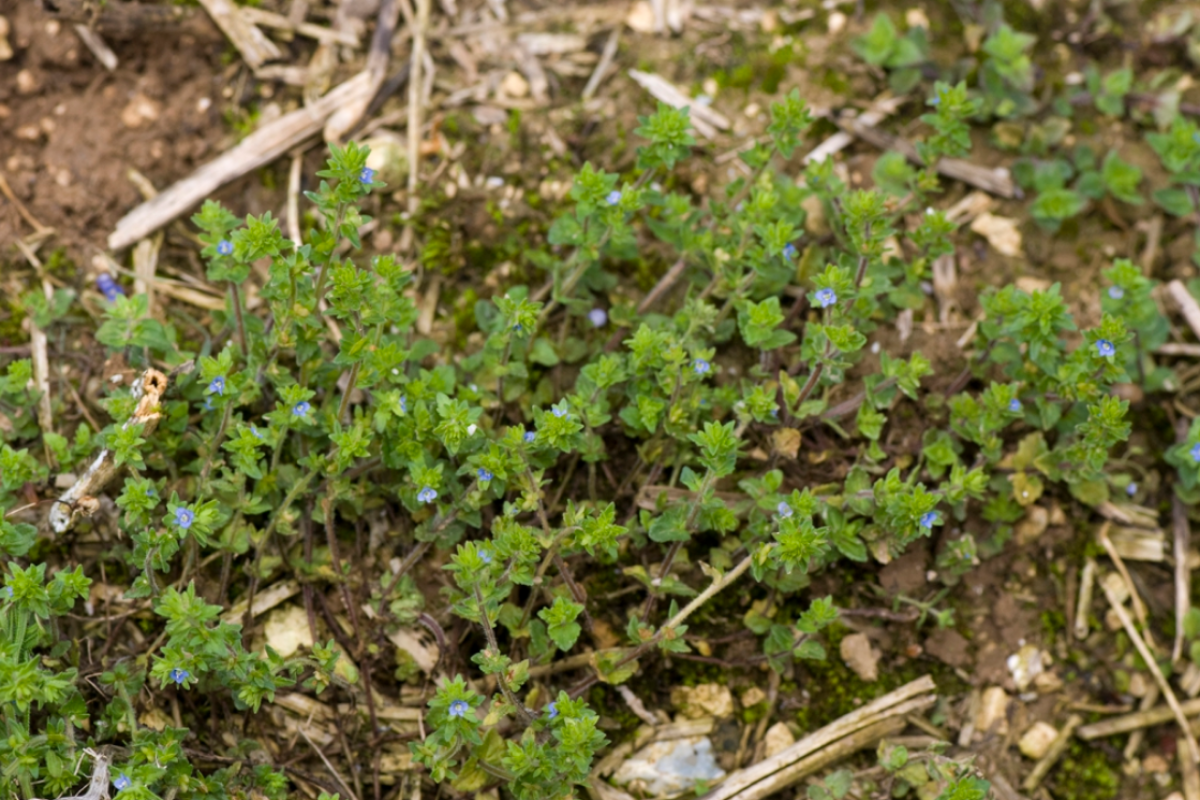
It is native to Europe, western Asia, and North America and commonly grows on lawns, roadsides, meadows, vineyards, cropping systems, orchards, and waste areas.
The species can be recognized by its hairy stems, alternate upper leaves, opposite lower leaves, heart-shaped fruit, and small, bluish-violet flowers.
Corn Speedwell Classification
- Domain: Eukaryota
- Kingdom: Plantae
- Phylum: Tracheophyta
- Subphylum: Angiospermae
- Class: Magnoliaspida
- Order: Lamiales
- Family: Plantaginaceae
- Genus: Veronica
- Species: Veronica arvensis
- Common Names: Common Speedwell, Field Speedwell, Wall Speedwell, and Speedwell
Nativity and Distribution
Common Speedwell is native to Europe, western Asia, and North America. Today, it is naturalized in other regions, including:
- North America
- South America
- New Zealand
- East Asia
- Australia
Physical Characteristics
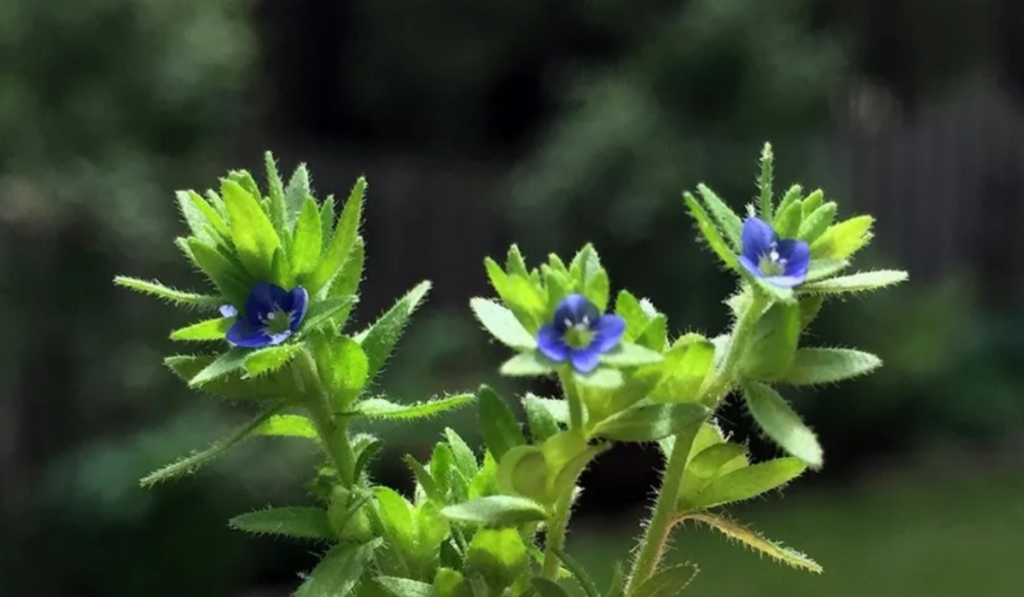
- Leaves: Hairy, medium to dark green, measuring 5-25 mm long
- Fruits: Small, heart-shaped capsule about 3-5 mm long
- Stems: Slender, green, hairy, reaching 5-30 cm in height
- Flowers: Small, bluish-violet blooms, about 2-5 mm wide
- Roots: Fibrous root system
Corn Speedwell is a small, fast-growing winter annual that typically grows 5-30 cm tall with a spread of 10-30 cm wide, to form low patches. You can recognize the plant by its hairy stems, alternate upper leaves, opposite lower leaves, heart-shaped fruit, and small, bluish-violet flowers.
Stems are slender, green in colour, densely covered with fine hairs, and typically branching at the base. Depending on the growing conditions, the stems may be upright or slightly spreading across the ground.
Veronica arvensis leaves are small, hairy, medium to dark green in colour, with shallowly toothed margins. The lower leaves are opposite, round to broadly oval, about 9 – 12mm long with very short stems. The upper leaves are alternate, linear-oblong to lanceolate in shape.
Corn Speedwell produces small, pale blue to bluish-violet, and occasionally white flowers, measuring 2-5 mm wide, arising from the upper leaf axils. Each flower is four-petaled, with one of the petals appearing smaller than the others, a distinct feature of the genus Veronica.
The seed is small, smooth, oval, yellowish-orange, and measures about 0.7mm long.
Reproduction, Dispersal, and Life Cycle
- Life Cycle: Annual
- Seeds: A single plant can produce 1,000 – 70,000 seeds
- Climate: Thrives best in temperate climates
- Dispersal: Falling, animal, and human activity
Veronica arvense behaves primarily as a winter annual but can be a spring or summer annual in cooler climates. The species typically germinates in cooler seasons, flowers in spring, sets seed, and dies in midsummer.
Corn Speedwell reproduces by seeds. A single mature plant can produce 1,000 – 70,000 seeds depending on the size and environmental conditions. The seeds are mostly dispersed by falling beneath the parent plant after the capsules split.
Animals may move seeds that adhere to fur or hooves over short distances. Surface runoff, contaminated equipment and footwear, and soil movement can also facilitate dispersal.
The species thrives in temperate climates, where cooler temperatures, full sun to partial shade, and moist, well-drained soil conditions are present. It can tolerate dry soils where there is little to no competition. However, it may not tolerate prolonged drought.
Speedwell is commonly located on roadsides, lawns, cultivated fields, streambanks, forests, savannas, and waste areas.
Similar Plants
- Veronica persica
- Veronica agrestis
- Veronica polita
- Veronica hederofolia
Uses
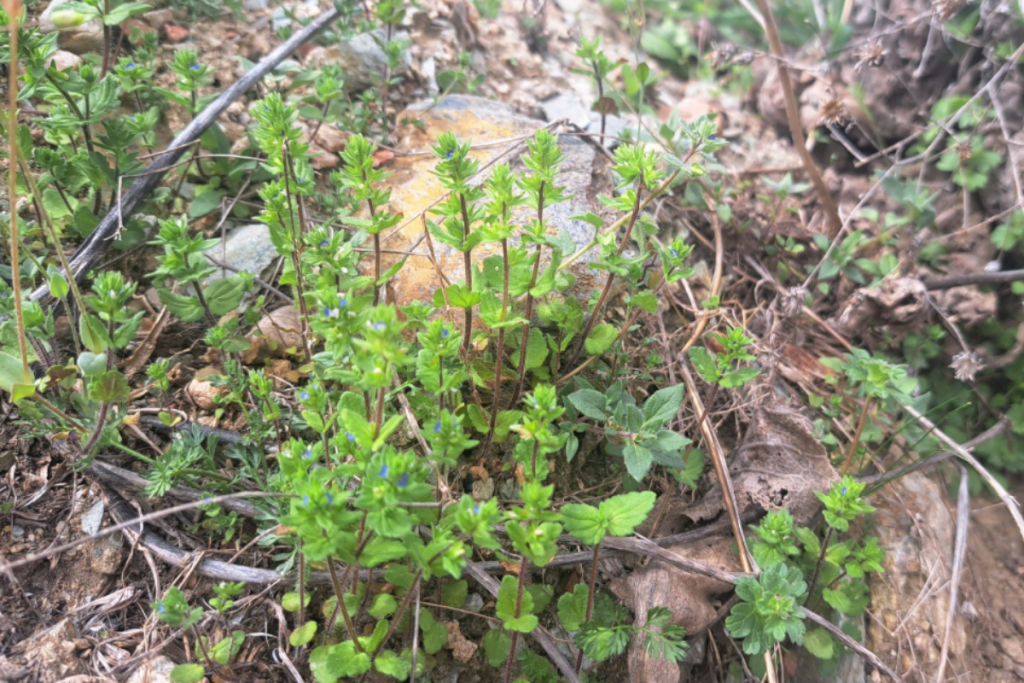
- Corn Speedwell is grown as a groundcover in naturalized landscapes.
- It is grown in pollinator gardens as a nectar source for bees and other beneficial insects.
- The plant is used as traditional herbal medicine for mild respiratory and digestive problems in parts of Europe.
- Speedwell is grown on bare areas to prevent soil erosion in the winter and spring.
Impact on Farms and Environment
Veronica arvensis is a common agricultural weed, especially in winter crops like cereals and vegetables. The weed has a similar growth cycle to the crops and, therefore competes with young plants for important resources.
Due to its patch formations, dense infestations can interfere with seedling germination and harvesting. Large infestations in cultivated fields ultimately lead to increased weed management costs.
The broadleaf weed is commonly sighted in thin, nutrient-deficient, damaged, or compacted lawns, reducing the health and aesthetic appeal.
Corn Speedwell is an important nectar source for beneficial pollinators and also prevents erosion in bare areas. However, large infestations can outcompete native annuals, negatively impacting biodiversity. That said, it is considered less aggressive than other species.
Control
- Mechanical control: Hand-pulling, hoeing, and mulching
- Cultural control: Maintaining a healthy turf
- Chemical control: Herbicides like dithiopyr, pendimethalin, and 2,4-D
Hand-pulling and hoeing are effective strategies for removing young plants. Corn Speedwell has shallow fibrous roots and is relatively easy to pull in moist soil.
Mulching can suppress the weeds in ornamental beds, vegetable gardens, and around trees. A 3-4 inch layer of mulch will block sunlight, inhibiting seed germination.
For Corn Speedwell control on turf, incorporate practices that promote a healthy turf like growing well-adapted turfgrasses, regular mowing, and timely nitrogen fertilization.
Applications of various preemergence and postemergence herbicides can also provide effective control for Veronica arvensis. Preemergence herbicides include products containing active ingredients like dithiopyr, pendimethalin, or a combination of prodiamine + sulfentrazone.
For established populations, postemergence herbicides such as amicarbizone, 2,4-D, sulfentrazone, and numerous combinations of other active ingredients can be applied in turf and ornamentals.
Consult an extension expert if you require help to choose the best herbicide for your site. Ensure to read and follow the product label regarding applications and timings for the best results.

Lead Editor for Insight Weeds.