Spergularia rubra is a low-growing annual or short-lived perennial in the Caryophyllaceae family that grows 5-25 cm long. It is native to Asia, North Africa, and Europe and is commonly found in sandy soils, cultivated fields, lawns, coastal sites, roadsides, and disturbed sites.
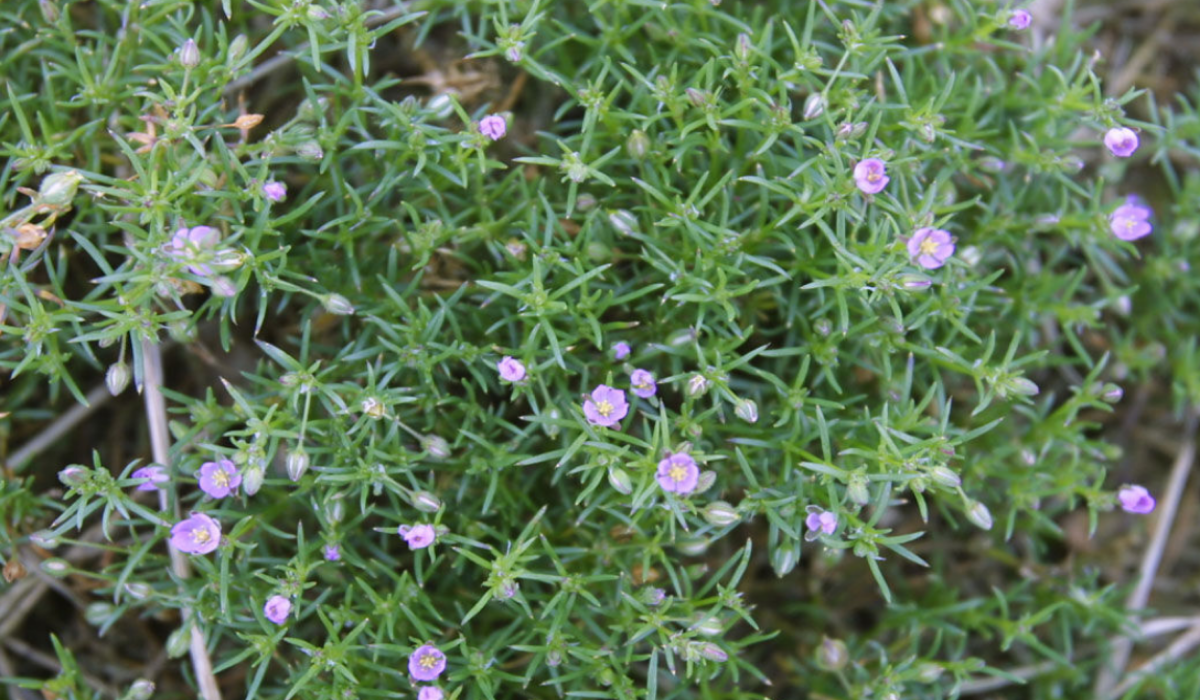
It is easily recognizable by its slender, reddish-green stems, narrow leaves with papery stipules, and small, pink to reddish five-petaled flowers.
Red Sand Classification
- Domain: Eukaryota
- Kingdom: Plantae
- Phylum: Tracheophyta
- Subphylum: Angiospermae
- Class: Magnoliaspida
- Order: Caryophyllales
- Family: Caryophyllaceae
- Genus: Spergularia
- Species: Spergularia rubra
- Common Names: Red Spurrey, Red Sandspurry, Sandspurry, and Field Spansurry
Nativity and Distribution
Red Sand Weed is native to Asia, North Africa, and Europe. It has since been introduced and naturalized in Australia, North America, South America, New Zealand, and parts of Southern Africa.
Physical Characteristics
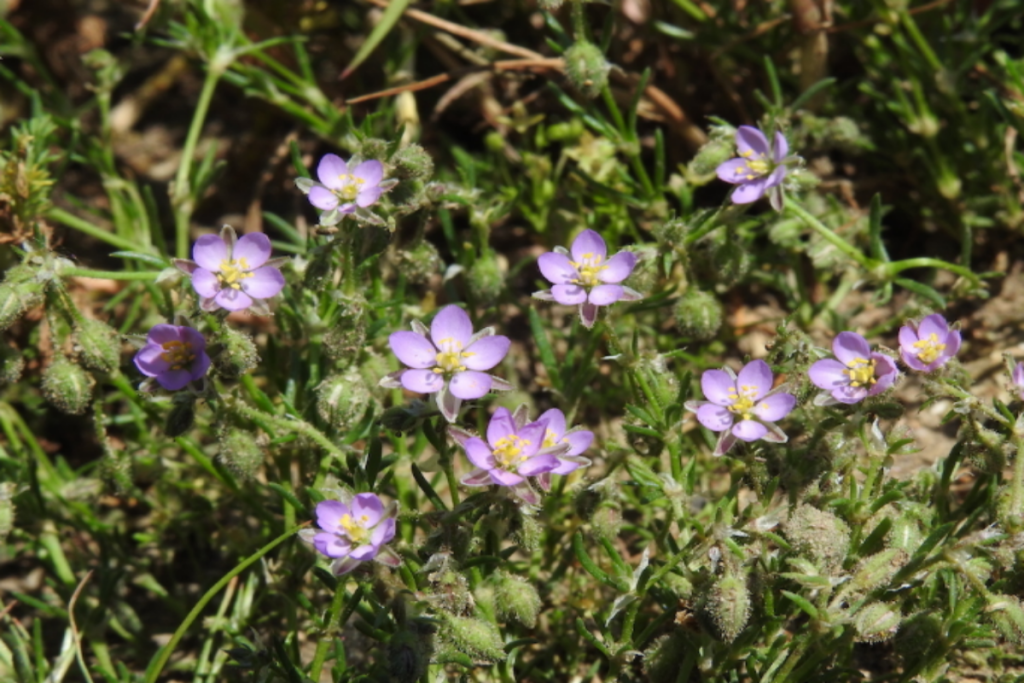
- Leaves: Narrow, opposite, grey-green, thread-like leaves
- Fruits: Small, ovoid to globular capsule
- Stems: Slender, much-branched, reddish-green, 5-25 cm long
- Flowers: Small, pink to reddish, five-petaled blooms
- Roots: Taproot system
Red Sandspurry is a low-growing weed that typically grows 5-25 cm long. You can recognize the species by its slender, reddish-green stems, narrow leaves with papery stipules, and small, pink to reddish five-petaled flowers.
The stems are slender, much branched, reddish to reddish-green in colour. They often trail on the ground to form low mats and rarely root at the nodes. Occasionally, they may also be uprising, giving the ability to tolerate wind and light foot traffic.
Sandspurry leaves are narrow, oppositely arranged or clustered along the stems, grey-green, and about 5-30 mm long. They are fleshly or somewhat succulent, which allows the species to retain water in dry environments. The leaves are pointed or spine-tipped and feature white, lance-shaped, papery stipules at the base of the leaf pair.
Spergularia rubra flowers are small, 4-8 mm wide, pink to reddish-pink in colour. The flowers are typically 5-petaled, and the petals are shorter than the sepals. Blooms are borne singly or in loose clusters at the tips of the stems. Flowering occurs from spring to autumn, depending on the prevailing conditions.
The seed is small, broadly pear-shaped, dark to reddish brown, and 0.4 – 0.6 mm long.
Reproduction, Dispersal, and Life Cycle
- Life Cycle: Annual or short-lived perennial
- Seeds: A single plant can produce 2,000 – 7,500 seeds
- Climate: Thrives best in temperate, tropical, and subtropical climates
- Dispersal: Expulsion, animals, wind, water, and contaminated machinery
Spergularia rubra behaves primarily as an annual, although it may also behave as a short-lived perennial in milder climates. This species mainly reproduces by seed, with a single healthy plant typically producing between 2,000 and 7,500 seeds.
The seeds mainly fall beneath the parent plant and begin germination where moisture is available. Other seeds are dispersed by water runoff, wind, and contaminated machinery or material.
Since the seeds underground remain viable for many years, human activities like landscaping, cultivation, and road maintenance also facilitate significant seed dispersal and germination.
Red Sand Weed thrives best in temperate climates with cool to warm seasons. Ideal growing conditions include well-drained sandy or gravel soils, moderate rainfall, and full sun. The slender taproot helps the species persist in dry, poor soils, while the woody root system anchors the weed in loose sandy soils.
The weed can tolerate drought well because of its fleshy, somewhat succulent leaves that reduce water loss in dry habitats.
Red Spurrey commonly grows in sandy soils, cultivated fields, lawns, coastal sites, gravel areas, roadsides, open habitats, and disturbed sites.
Similar Plants
- Spergularia marina
- Spergularia media
- Spergula arvensis
- Sagina procumbens
- Arenaria serpyllifolia
Uses
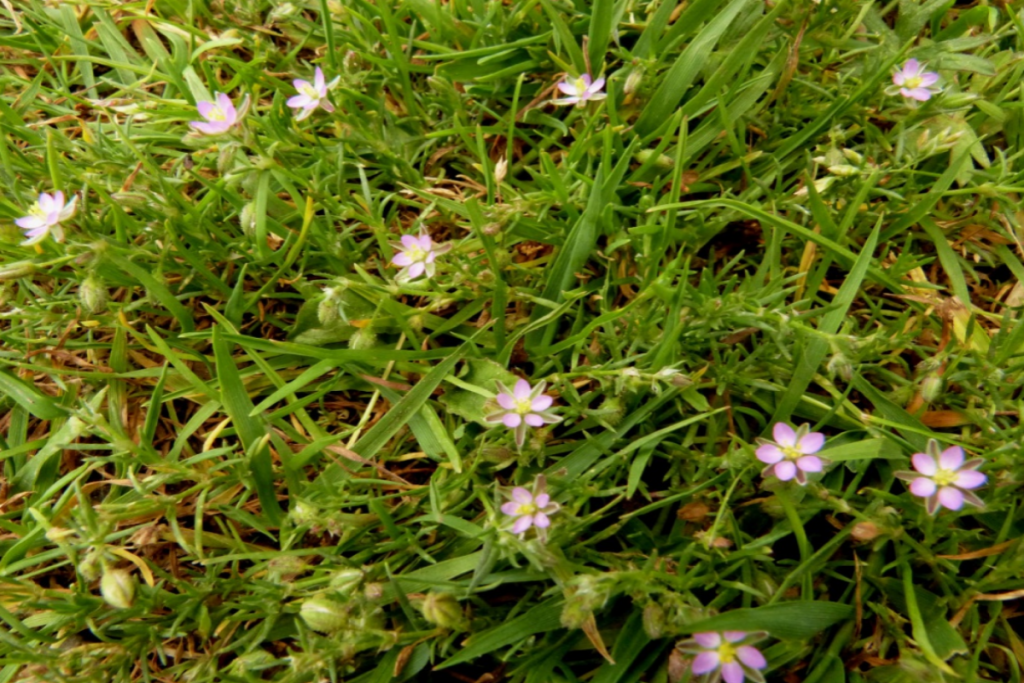
- It serves as a food source for insects and small, seed-eating birds.
- Sandspurry is grown as groundcover on poor, sandy soils where other vegetation may struggle to establish.
- The plant is a preferred pioneer species on bare areas and also helps to reduce minor soil erosion in disturbed areas.
Impact on Farms and Environment
Spergularia rubra is considered more of a nuisance than a major weed in agricultural settings. The weed can invade crop fields, vegetable gardens, nurseries, and lawns, competing for important resources.
However, due to its small size, it does not severely impact crop quality. That said, the persistent seed bank or large infestations will ultimately increase weed control costs.
In environmental habitats, Red Sand Weed is an important nectar source for small insects. It often occupies bare areas, but it does not spread aggressively.
Control
- Mechanical control: Handpulling, hoeing, and cultivation
- Cultural control: Maintaining a healthy turf
- Chemical control: Application of herbicides like glyphosate or 2,4-D + glyphosate
Red Sandspurry has a shallow taproot system that is easy to pull by hand. Pulling should be done when the plants are young and actively growing to prevent flowering or seed set.
In vegetable gardens and ornamental landscapes, hoeing or cultivation can effectively control the weeds. Repeated tillage will exhaust the seed bank by encouraging germination, which, when followed by removal before seed set, minimizes spread.
Maintaining a healthy turf and dense ground cover can help suppress seedling establishment. Minimizing bare spots and improving soil fertility where applicable will discourage colonization.
Where large infestations are present, herbicides like oryzalin, norflurazon, 2,4-D, or glyphosate can eradicate the weeds. Ensure that you choose the right product for your area and follow local regulations to avoid injuring desirable vegetation.

Lead Editor for Insight Weeds.