Cirsium arvense is a rhizomatous perennial herb in the Asteraceae family that grows 30-150 cm tall. It is native to Western Asia, North Africa, and Europe, and typically inhabits meadows, pastures, roadsides, crop fields, gardens, and grasslands.
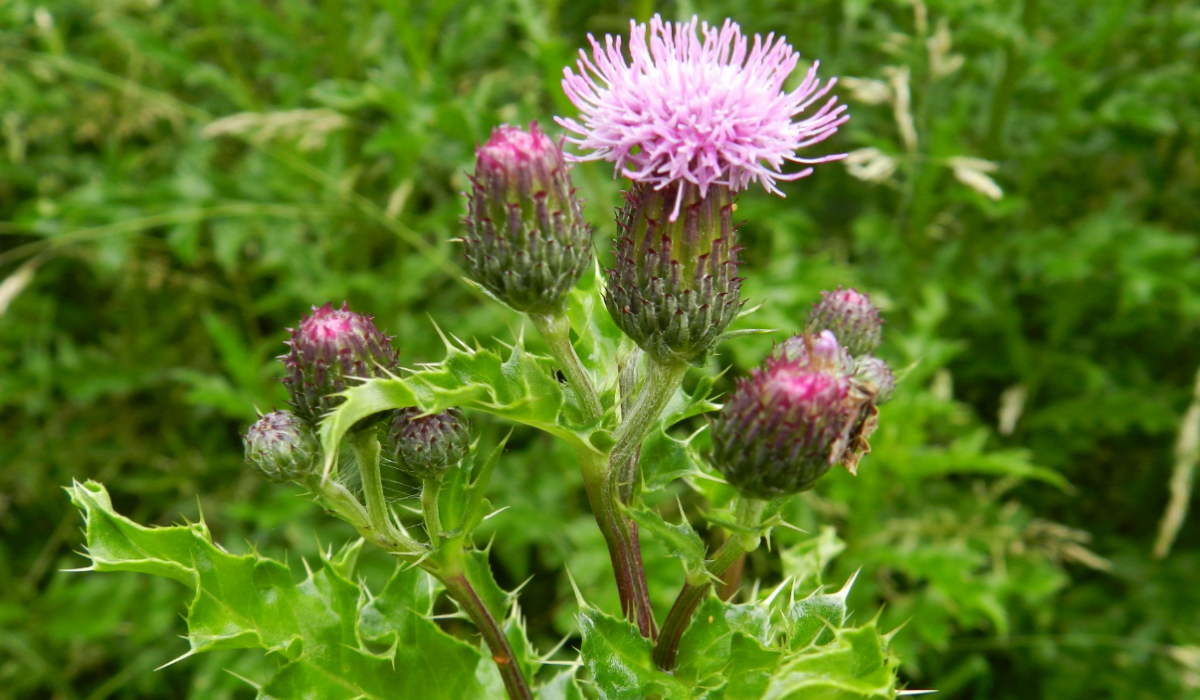
You can recognize the species by its branching stems, narrow prickly leaves with wavy margins, and clusters of pink or purple flowerheads.
Creeping Thistle Classification
- Domain: Eukaryota
- Kingdom: Plantae
- Phylum: Tracheophyta
- Subphylum: Angiospermae
- Class: Magnoliaspida
- Order: Asterales
- Family: Asteraceae
- Genus: Cirsium
- Species: Cirsium arvense
- Varieties: Cirsium arvense var. arvense and Cirsium arvense var. incanum
- Common Names: Common Thistle, Canada Thistle, Swamp Thistle, Prickly Thistle, Cursed Thistle, Small-Flowered Thistle, Field Thistle, Corn Thistle, and California Thistle
Nativity and Distribution
Cirsium arvense is native to western Asia, North Africa, and Europe. It has since been introduced in other regions globally, including Australia. North America, South America, southern parts of Africa, and East Asia.
Physical Characteristics
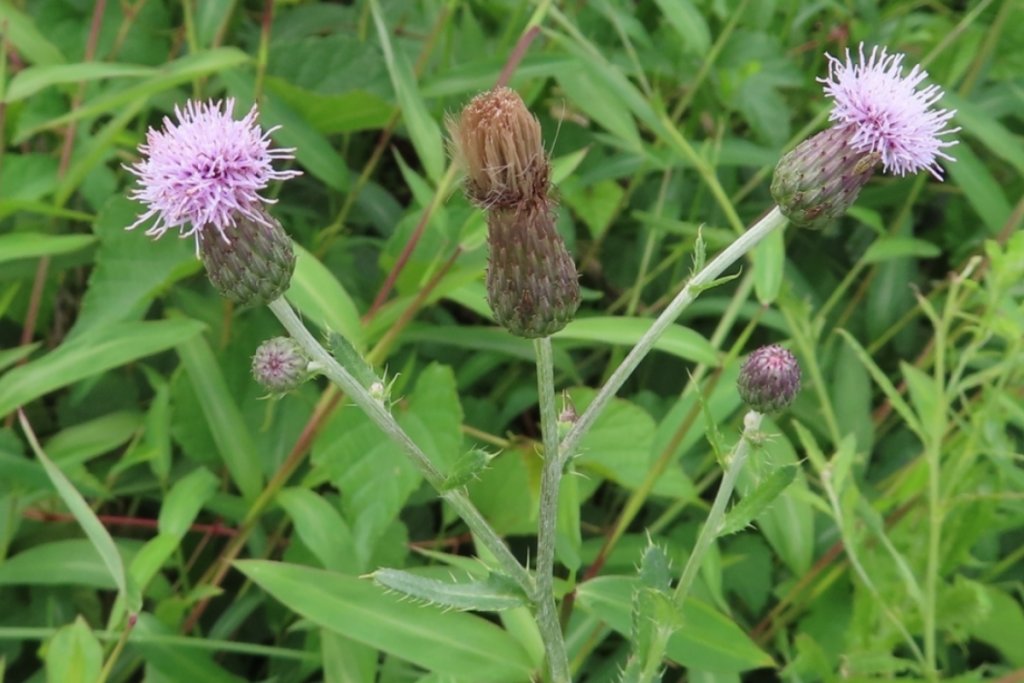
- Leaves: Alternate, narrow, lobed, with spines along wavy margins
- Fruits: Small, dry achene with feathery pappus, 3 -5 mm long
- Stems: Erect, smooth to slightly hairy, grooved, growing 30 -150 cm tall
- Flowers: Clusters of pink to purple flowerheads, 1-2 cm wide
- Roots: Vertical and horizontal root systems
Canada Thistle is a rhizomatous perennial herb that grows 30-150 cm tall. You can easily recognize it by its branching stems, narrow prickly leaves with wavy margins, and clusters of pink or purple flowerheads.
Stems are erect, typically smooth or slightly hairy, branched especially on the upper portions, but distinctly without ridges. They arise from a creeping root system to form new plants.
The leaves come in two forms. The basal leaves are formed in rosettes and are smooth, oblong to lanceolate, with wavy and spiny margins. The upper leaves are alternate, sessile, sometimes shallowly or deeply lobed, smaller, about 15-20 cm long and 2-3 cm wide, with spiny margins.
Creeping Thistle produces pink, pinkish-purple, lilac, and occasionally white flowerheads, about 1-2 cm wide. They occur singly or in clusters at the tips of the stems and comprise numerous disks with projecting pistils subtended by spine-tipped bracts.
Male and female flowers look similar but are found on different plants. A fragrant scent and seed production on the female flowers can help distinguish them. Flowering occurs in
The seed is small, 4-5 mm long, with a white, feathery pappus.
Reproduction, Dispersal, and Life Cycle
- Life Cycle: Perennial
- Seeds: A single mature plant can produce 1,500-5,000 seeds
- Climate: Thrives best in temperate climates
- Dispersal: Wind, water, and human activities
Creeping thistle behaves as a perennial. It primarily reproduces by seed and a rhizome system. A single mature plant can produce between 1,500-5,000 seeds annually or more.
Each achene features a white, feathery pappus that allows for efficient wind dispersal. When the seeds and pappi mature, the white plumes can be seen floating in the air and covering vast areas on the ground.
Other seeds can be dispersed by water, as part of contaminated hay or livestock feed, through soil movement, and through contaminated farming machinery. The seeds readily germinate within the first few years as they don’t need a dormancy period as long as favorable conditions prevail. However, buried seeds can remain viable for over 20 years.
Basal leaves emerge after seed germination in mid-spring, leading to the growth of branching stems throughout summer and fall. The species develops a deep vertical root, about 6 feet in the soil.
The vertical root extends horizontally to about 15 feet, forming a massive network that supports vast patch and colony regrowth year after year.
A new shoot emerges from an underground bud, flowers, and seeds by autumn, and after frost, the above-ground growth dies back. The underground roots store energy in winter to support new growth in the next season.
Cirsium arvense thrives in temperate climates, where moist, well-drained loamy soils and full sun or partial shade conditions are present. However, this species can adapt to a wide range of soils and can tolerate prolonged frost.
The weed can be found in meadows, grasslands, pastures, crop fields, forest margins, roadsides, waste areas, and disturbed sites.
Similar Plants
- Cirsium vulgare
- Cirsium lanceolatum
- Cirsium palustre
- Carduus nutans
Uses
- Creeping thistle is grown in pollinator gardens to provide nectar and pollen for bees, butterflies, and other pollinating insects.
- After careful preparation, young shoots, peeled stems, and leaves are consumed as wild vegetables.
- The plant has been used as traditional medicine for toothache, indigestion, and other minor ailments.
- The feathery pappus is used by the Cherokee to fletch blowgun darts.
Impact on Farms and Environment
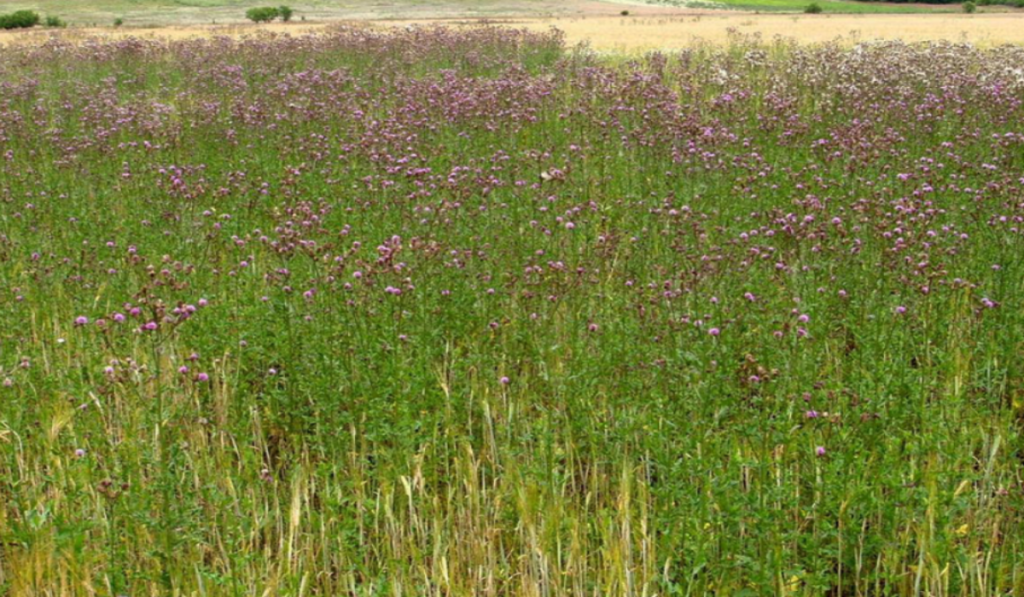
Field Thistle is considered a serious weed in agricultural settings. It is listed as a noxious weed in several countries, including Canada, New Zealand, Australia, and 43 states in the United States.
Its ability to form dense infestations that compete aggressively with crops for important nutrients significantly reduces the quantity and quality of yields.
The species is also a known host for aphids that can spread disease to desirable crops, leading to losses. Its large seed bank, root system, and growth patterns make it a difficult and expensive weed to control, further compounding farming costs.
The weed outcompetes desirable pastures, reducing the quality of grazing grounds and hayfields. Additionally, the sharp spines discourage livestock from grazing, leading to uneven grazing and loss of usable forage.
In natural ecosystems, the invasive weed can displace native plants and reduce biodiversity, especially in disturbed habitats.
Dense infestations in turfgrasses often reduce their aesthetic appeal and become a nuisance for ball retrieval on golf courses.
Control
- Mechanical control: Digging, repeated mowing, and cutting
- Cultural control: Maintaining healthy pastures and growing dense crops
- Chemical control: Application of broadleaf herbicides
Digging out young plants can help control the spread of the weed in agricultural and ornamental settings. However, repeated digging is required over several growing seasons for effective control.
In lawns, repeated mowing and cutting young plants before flowering are common practices for Creeping Thistle control, as it reduces underground food reserves. However, these strategies often require chemical herbicides for successful control.
Maintaining healthy perennial pastures and competitive crops in fields can also help reduce new shoot establishment. Growing alfalfa in forages, for instance, has been shown to reduce the spread and reestablishment of the weed.
Systemic herbicides generally provide the best control against Cirsium arvense because they target the entire plant down to the roots and rhizome system.
Applications are typically made in late spring to early autumn, after the young plants have emerged, for the most effective results. Repeat applications are often required to exhaust underground reserves and to achieve long-term control.
Postemergence herbicides containing products such as clopyralid, 2,4-D, aminopyralid, or glyphosate can be applied in turfgrasses, pastures, and crop fields.
If you’re unsure on the next best steps, consult an extension expert to get the best advice on Creeping Thistle control for your specific infested area.

Lead Editor for Insight Weeds.