Costus pictus is a rhizomatous perennial herb that typically grows 60-90 cm tall and up to 2.5m in some habitats. It is native to Mexico and Central America.
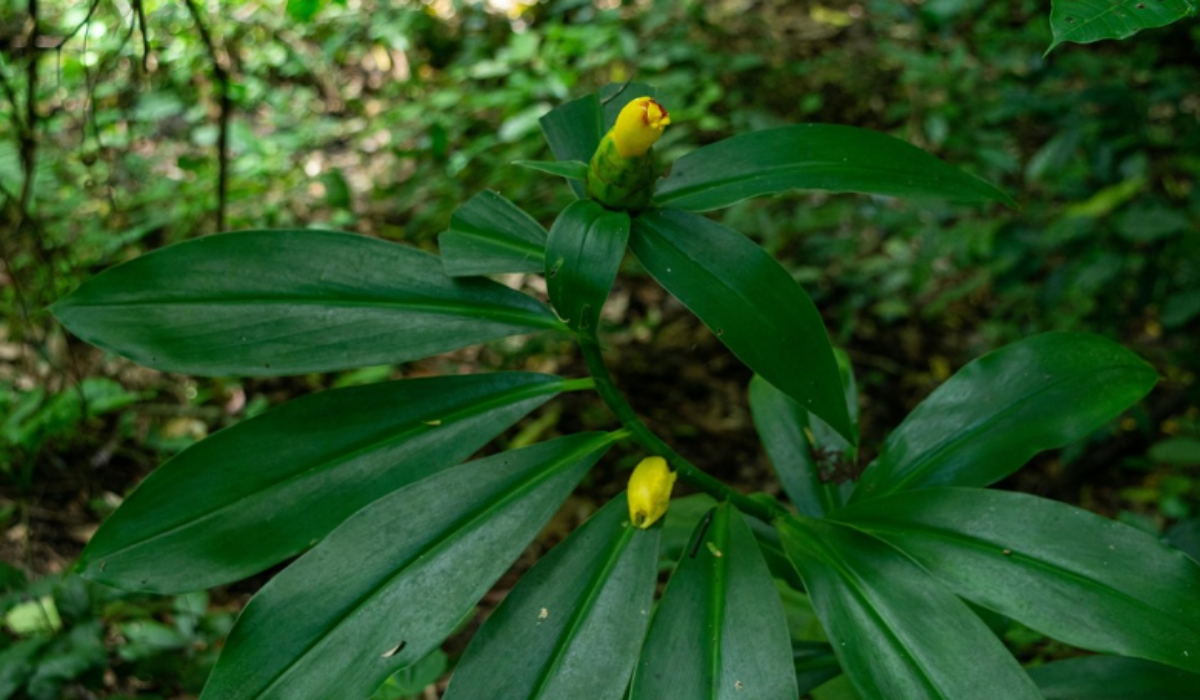
It is easily recognizable by its spiraling stems, long, glossy leaves spiraling around the stem, and showy, yellow flowers with orange-red stripes, emerging from cone-like bracts.
Painted Spiral Ginger Classification
- Domain: Eukaryota
- Kingdom: Plantae
- Phylum: Tracheophyta
- Subphylum: Angiospermae
- Class: Liliospida
- Order: Zingiberales
- Family: Costaceae
- Genus: Costus
- Species: Costus pictus
- Common Names: Spotted Spiral Ginger, Spiral Ginger, Sour Ginger, Insulin Plant, Insulin Ginger, Insulin Flower, Spiral Flag, Fiery Costus, and Step Ladder Plant
Nativity and Distribution
Spotted Spiral Ginger is native to tropical Mexico, Central America in countries like Costa Rica, Panama, Honduras, and Nicaragua, and the Caribbean region.
Today, it has been introduced in other regions, including North America, South Asia, particularly India, and parts of Africa.
Physical Characteristics
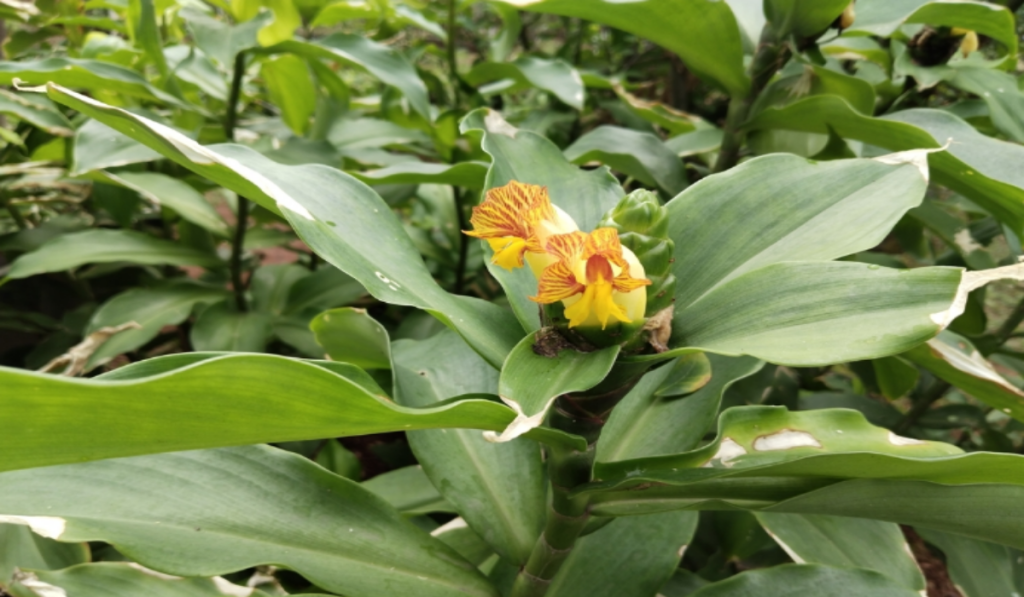
- Leaves: Simple, alternate, broad, elliptic to oblong, glossy green, 10-30 cm long
- Fruits: Dry capsule, globose, hairless to densely hairy, and brown in maturity
- Stems: Upright, fleshy, cane-like with spotted patterns
- Flowers: Yellow tubular blooms with orange-red stripes, about 5 cm long
- Roots: Rhizomatous root system
Costus pictus is a rhizomatous herb that typically grows 60-90 cm tall and up to 2.5m in some conditions. You can easily identify the plant by its spiraling stems, long, glossy leaves spiraling around the stem, and showy, yellow flowers with orange-red stripes, emerging from corn-like bracts.
Stems are erect, glabrous, cane-like structures that grow in a tight spiral pattern. They feature distinct red tinges with mottled, striped, and spotted patterns. While they may resemble real stems, they are actually pseudostems that form from overlapping leaf sheaths.
Painted Spiral Ginger leaves are simple, alternate, elliptic to oblong, about 10-30 cm long and 2.5-6 cm wide, with entire margins. They are glossy green on the upper surface, with the underside typically featuring a lighter coloration. The leaves spiral around the stems, giving the plant a unique architectural form.
C. pictus produces yellow, tubular flowers with orange-red stripes, about 5 cm long that appear on compact, globose to ovoid, cone-like bracts. The blooms resemble paper lanterns and typically last for one day, with the inflorescence bearing two new flowers every day.
Flowering occurs throughout the warmer months – late spring to early autumn. In warm, tropical environments, it can flower continuously for much of the year.
The seed is small, black, and enclosed in white arils, occurring in a dry capsule.
Reproduction, Dispersal, and Life Cycle
- Life Cycle: Perennial
- Seeds: Produces a few hundred seeds annually
- Climate: Thrives best in warm, tropical climates
- Dispersal: Splitting, animals, human activity, and vegetative propagation
Painted Spiral Ginger behaves as a perennial herb. When favourable conditions arise, new shoots emerge from the underground rhizomes, producing foliage and flowers throughout the growing season.
The stems die off in colder months as the rhizomes persist to restart the new growth when ideal conditions resume.
The seeds are produced in a dry capsule that breaks open when mature. They fall beneath the parent plant to begin germination, while other seeds are dispersed by animals and humans through ornamental and medicinal cultivation to new areas.
Spiral Ginger also reproduces through vegetative means, where rhizomes spread outward, producing new shoots that form dense colonies.
The perennial herb thrives best in warm, tropical climates with full sun or partial shade, and moist, well-drained soil conditions. It can’t tolerate frost and prolonged cold conditions.
Similar Plants
- Chamaecostus cuspidatus
- Costus woodsonii
- Costus dirzoi
- Costus glaucus
Uses
- Painted Spiral Ginger is a popular plant in ornamental gardens, valued for their distinctive spiral foliage form and showy flowers.
- The perennial is grown in pollinator gardens to attract butterflies and bees.
- The roots, leaves, rhizomes, and flowers are infused in water and taken as an herbal tea to treat kidney and urinary problems.
- The young stems are harvested and cooked as a vegetable.
- The acidic juice extracted from the young stems is used for blood sugar regulation and to treat bronchitis, colds, and fevers.
- The plant is used as a traditional remedy for skin conditions and stomach ailments.
- Juice extracted from the flowers is taken as a remedy for internal parasites and for treatment for vaginal infections.
Impact on Farms and Environment
Costus pictus is not considered an invasive or problematic plant in agricultural settings. When cultivated responsibly, it can provide income for growers specializing in herbal products. That said, it has the potential to escape and form formidable colonies if left unchecked.
In the environment, it is an important nectar resource for pollinators, making a positive contribution towards plant diversity in various habitats.
Control
- Mechanical control: Hand-pulling and digging
- Cultural control: Maintaining dense ground cover
For small populations, hand-pulling and digging of the rhizome portions can control the weed. Dispose of all remaining fragments properly to prevent regrowth. Repeated monitoring is also recommended to prevent regrowth from overlooked rhizomes.
For long-term control, consider maintaining a dense ground cover and reducing soil disturbance to limit the spread of seeds and germination.

Lead Editor for Insight Weeds.