Oxalis stricta is a small perennial herb in the Oxalidaceae family that grows 10-50 cm long with a spread of 15-45 cm. Its native habitat is highly debated, with certain sources attributing it to North America while others also citing Eurasia.
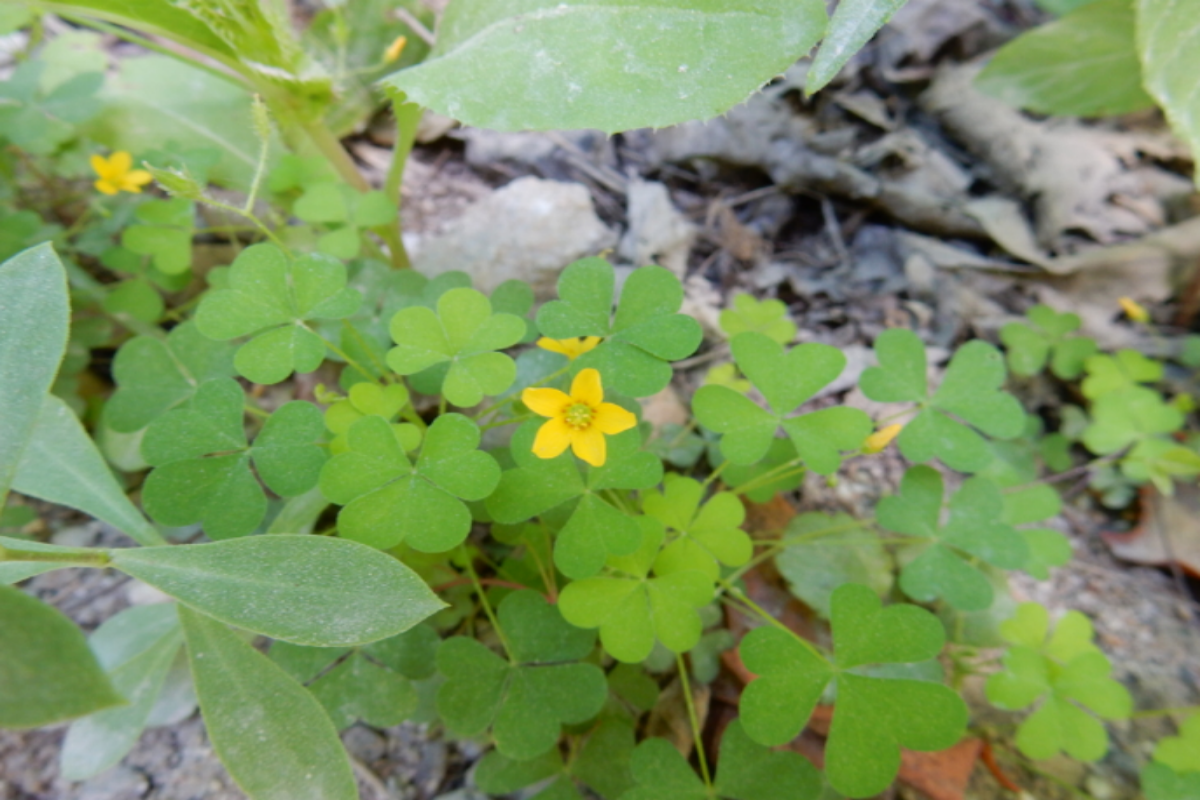
It is easily recognizable by its slender stems, trifoliate, heart-shaped leaves, and five-petaled, bright yellow flowers carried on long stalks above the leaves.
Common Yellow Woodsorrel Classification
- Domain: Eukaryota
- Kingdom: Plantae
- Phylum: Tracheophyta
- Subphylum: Angiospermae
- Class: Magnoliaspida
- Order: Oxalidales
- Family: Oxalidaceae
- Genus: Oxalis
- Species: Oxalis stricta
- Common Names: Yellow Woodsorell, Upright Woodsorell, European Woodsorell, Shamrock Plant, Lemon Clover, Oxalis, Common Oxalis, Sheep’s Clover, Pickle Plant, and Sourgrass
Nativity and Distribution
Yellow Woodsorrel nativity is commonly denoted as North America. However, some sources list broader native sources, including Eurasia.
As one of the most widespread species of Oxalis, it is naturalized in many regions throughout the globe, including Asia, Europe, parts of Africa, South America, New Zealand, and Australia.
Physical Characteristics
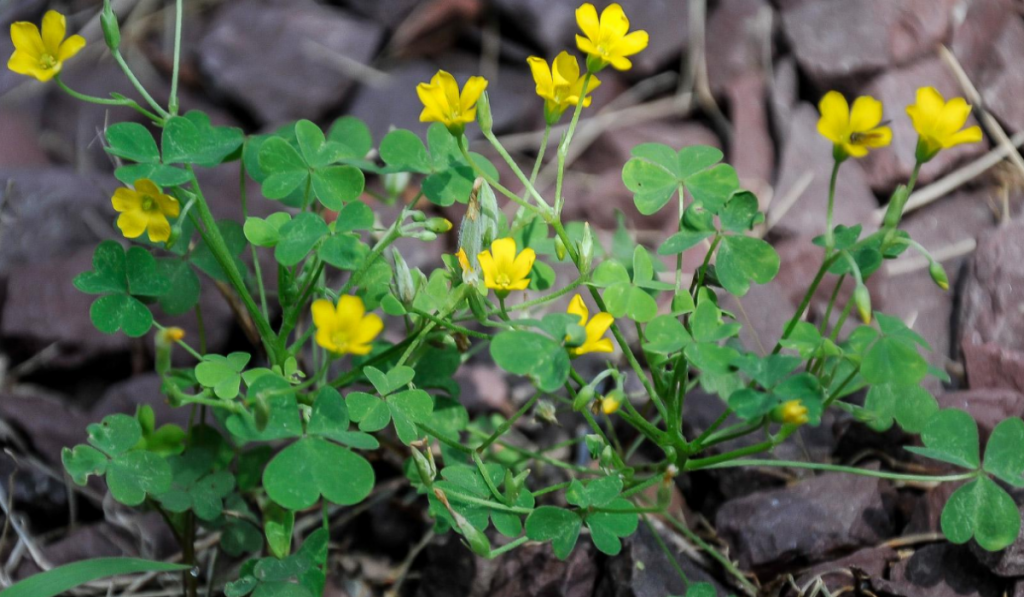
- Leaves: Alternate, trifoliate, heart-shaped leaflets, each 1.5 – 2.5 cm long
- Fruits: Slender, cylindrical capsule, about 1 – 2.5 cm long
- Stems: Slightly ascending to upright, slender, green, reaching about 10-50 cm long
- Flowers: Small, bright yellow, five-petaled blooms, 8-20mm wide
- Roots: Taproot system
Oxalis stricta is a small perennial herb in the Oxalidaceae family that grows 10-50 cm long with a spread of 15-45 cm. It is easily recognizable by its slender stems, trifoliate, heart-shaped leaves, and five-petaled, bright yellow flowers carried on long stalks above the leaves.
Stems are slender, green (although some may have a purple cast), erect, to slightly ascending, reaching up to 50 cm in height. They may be smooth to sparsely hairy, and often branch near the base.
The leaves are alternate, palmately compound, trifoliate, and bright to medium green. Each leaflet is distinctly heart-shaped, folded along the midrib, with entire margins, and measures 1-2.5 cm long. Oxalis stricta leaves, like many in this species, fold at night or when under stress.
Common Yellow Woodsorrel produces small, five-petaled, bright yellow flowers. They typically occur singly or in clusters of 2-5 on slender stalks above the leaves. Flowering occurs from late spring through autumn.
The seed is small, flattened, ridged along the surface, brown in colour, and about 1.0 – 15 mm long.
Reproduction, Dispersal, and Life Cycle
- Life Cycle: Perennial or long-lived annual
- Seeds: A single plant can produce up to 5,000 seeds
- Climate: Thrives best in temperate climates
- Dispersal: Ballistic dispersal, animals, and human activity
Yellow Woodsorrel behaves as a perennial or as an annual, depending on the environmental conditions. It mainly reproduces by seeds, which are borne in a slender, cylindrical capsule and occasionally through rhizomes and stolons.
When mature, the capsule ruptures explosively, scattering the seeds up to 4m away. This is its main means of dispersal. Other seeds can be dispersed on waterways and animals through attachment to hooves or as manure.
Human movement can also transport the seeds to new locations through contaminated soil, shoes, and machinery.
Newly produced seeds germinate immediately with an almost 100% germination rate, especially in recently disturbed soils. The seeds located underground can remain viable for five or more years in undisturbed soil, with a 83% viability in the first year.
Oxalis thrives best in temperate climates. This species prefers fertile, moist soil and full sun or partial shade. It can tolerate a wide range of soil conditions, short drought spells, and light frost, but cannot tolerate extended frost and prolonged drought.
Common Yellow Woodsorrel commonly grows in gardens, lawns, golf courses, athletic fields, agricultural fields, sidewalks, roadsides, forests, and disturbed sites. It is a common indicator of moist, fertile, or lightly disturbed sites.
Similar Plants
- Trifolium repens
- Medicago lupulina
- Oxalis corniculata
- Oxalis dillenii
Uses
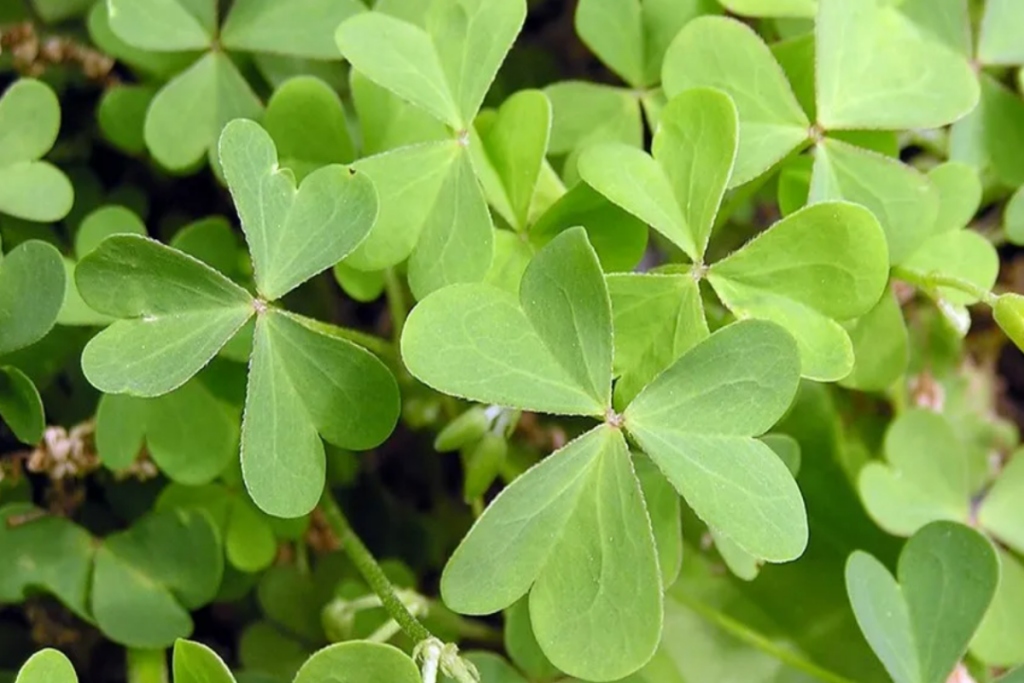
- Leaves of young plants are cooked as vegetables or added to salads.
- The plant is used as traditional medicine for treating minor wounds, digestive disorders, and fevers.
- It provides forage for grazing animals and birds.
- The Shamrock Plant is grown as a groundcover for naturalized gardens.
Impact on Farms and Environment
Oxalis stricta is considered a common agricultural and horticultural weed. It competes for important resources in perennial crop systems, nurseries, greenhouses, and vegetable gardens. What makes it a pesky weed is its large seed bank, efficient dispersal strategies, quick growth, and its wide spread.
Yellow Woodsorrel is also a known host for several fungi-causing diseases, including Fusarium and Puccinia, that can cause losses, especially in field and vegetable crops like onions, peppers, sweet potatoes, rye, wheat, barley, and sweet corn.
Consistent pulling and mowing removal practices often increase weed-control costs, especially where large infestations occur, and these interventions don’t guarantee complete control. Additionally, the dense infestations reduce crop vigor and interfere with harvesting, further increasing costs.
On lawns, the late-growing weeds often fill up the spots once taken by broadleaf weeds that have been killed by early emergence herbicides. Apart from increasing maintenance costs, the invasion also reduces the aesthetic appeal of lawns.
Control
- Mechanical control: Hand-pulling, tillage, and mulching
- Cultural control: Maintaining a healthy turf
- Chemical control: Application of pre-emergent or post-emergent herbicides
Hand-pulling is effective for removing young plants. It is most effective when the soil is moist, and if the entire taproot system is removed to prevent regrowth.
Common Yellow Woodsorrel is not common in untilled fields. Therefore, if you pull a few plants in a previous season in crop fields, repeated shallow cultivations before planting can help flush out the seeds in the soil in the subsequent season.
Mulching is a common control practice typically applied in ornamental settings where pulling, digging, or herbicide application may be impractical. A 3-4 inch layer of organic mulch will suppress seed germination by blocking sunlight, which is an essential requirement for Oxalis growth.
Maintaining a healthy, dense turfgrass through proper fertilization and good crop spacing in cropping systems reduces space for weed germination. Avoid excessive soil disturbance and overwatering, both of which encourage seedling germination.
Preventing growth through the application of preemergence herbicides provides the best control for Oxalis stricta. Products containing prodiamine, indaziflam, dithiopyr, and pendimethalin are commonly used in nurseries and turfgrass.
Postemergence herbicides containing combinations of dicamba, 2,4-D, and MCPP will control young seedlings effectively.
Application of herbicides requires location-specific recommendations, and it’s important to consult an extension expert for the best results.

Lead Editor for Insight Weeds.