Salvia azurea is a tall, delicate, perennial wildflower that grows 3-5 feet tall. It is native to central and eastern North America and Northern Mexico.
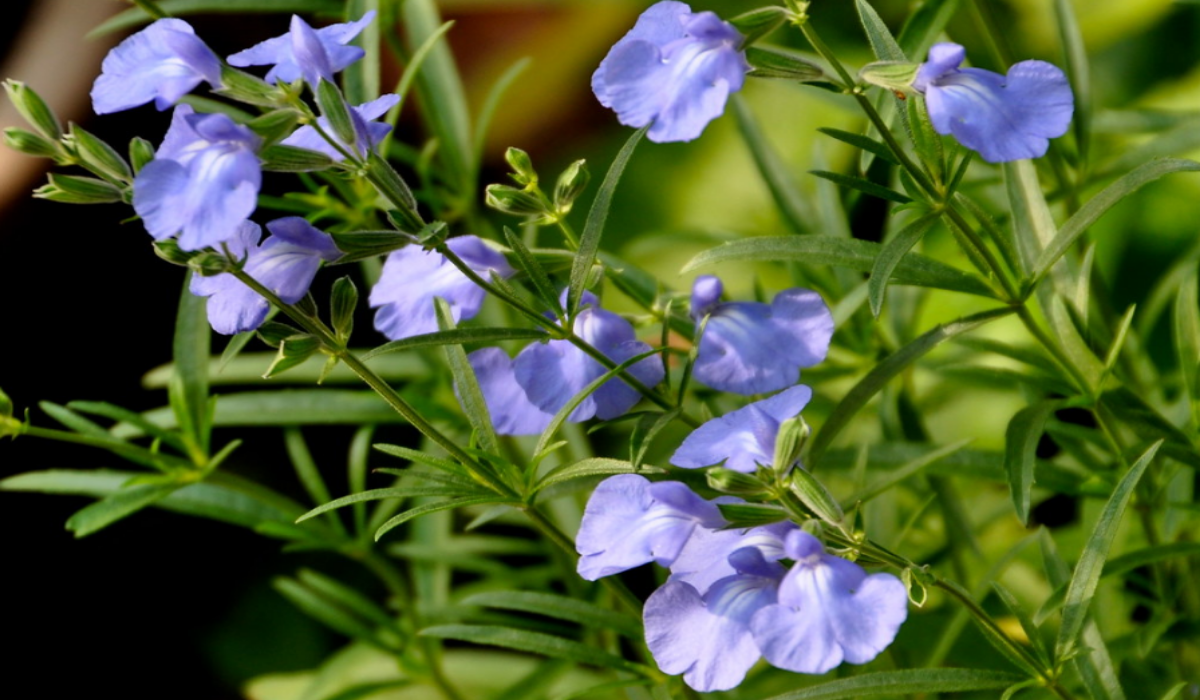
It is easily identified by its showy, azure-blue flowers, ovate to lanceolate grayish-green leaves, and square stems.
Azure Blue Sage Classification
- Domain: Eukaryota
- Kingdom: Plantae
- Phylum: Tracheophyta
- Subphylum: Angiospermae
- Class: Magnoliaspida
- Order: Lamiales
- Family: Lamiaceae
- Genus: Salvia
- Species: Salvia azurea
- Varieties: Salvia azurea var. azurea, Salvia azurea var. grandiflora
- Common Names: Azure Blue Sage, Azure Sage, Blue Sage, Prairie Sage, Pitcher Sage, and Sky Blue Sage
Nativity and Distribution
Azure Blue Sage is native to the central and eastern regions of North America. The native range includes the states of Kansas, Tennessee, Missouri, Nebraska, Georgia, Florida, Arkansas, the Carolinas, and Northern Mexico.
Physical Characteristics
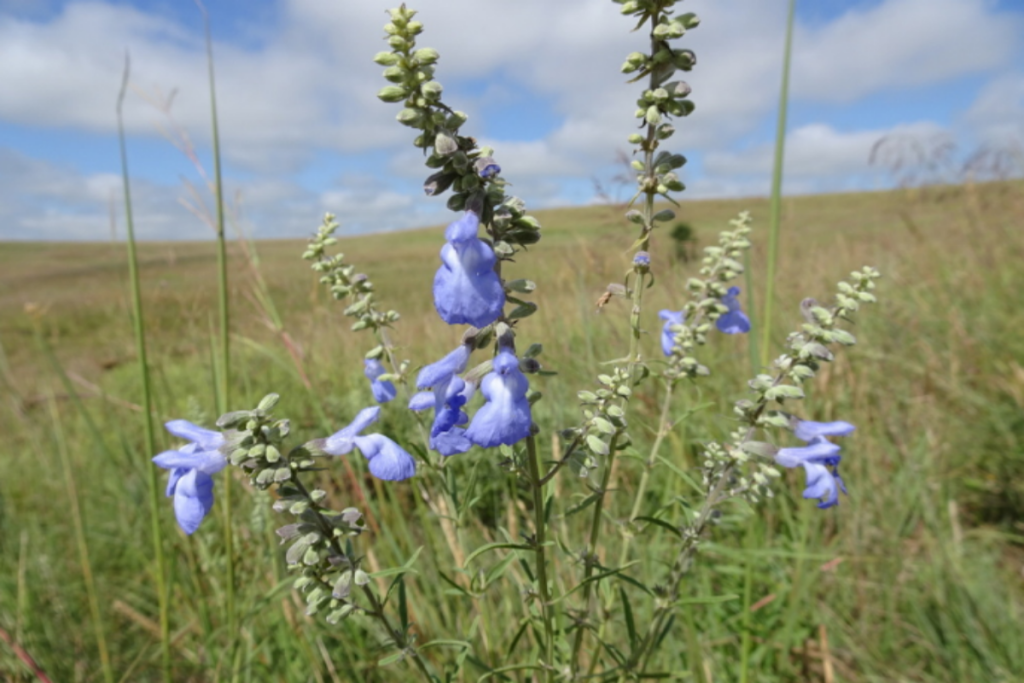
- Leaves: Simple, linear, ovate to lanceolate, grayish-green in colour, 7-10 cm long
- Fruits: Mottled, ovoid nutlets 2-3 mm, brown to copper in colour
- Stems: Upright, slender, and square in cross-section
- Flowers: Showy, sky-blue, two-lipped tubular flowers, 6-12 mm long
- Roots: Tap root
Azure Blue Sage is a tall, delicate, herbaceous wildflower in the Lamiaceae family that grows between 3 and 5 feet tall. It is native to central and eastern North America and Northern Mexico. It is easily identified by its showy, azure-blue flowers, narrow grayish-green leaves, and square stems.
Stems are square in cross-section, characteristic of the Lamiaceae family. They may be branched or unbranched and typically arise from a thick crown. While they are mostly upright, they can also appear floppy when flowers are in full bloom.
Azure Sage leaves are simple, linear, ovate to lanceolate, and oppositely arranged along the stems. They are typically grayish-green to silver, with smooth to slightly toothed margins, and can grow 7-10 cm long. The foliage has an aromatic scent and taste, hence the name.
S. azurea produces showy, blue, two-lipped tubular flowers 0.6-1.3 cm long. The individual blooms are arranged in loose terminal spikes and feature 4-5 fused petals. Flowering occurs from summer into fall.
The seeds are small, brown to dark, and nutlet-type in appearance.
Reproduction, Dispersal, and Life Cycle
- Life Cycle: Perennial
- Seeds: A single plant can produce 500 – 1,000 seeds
- Climate: Thrives best in temperate climates
- Dispersal: Self-splitting, wind, and animals
Pitcher sage is a long-lived herbaceous perennial with new shoots emerging in spring and the cycle ending with die-back of the above-ground portions after frost in late autumn and winter.
Each seed pod contains four nutlets, with each nutlet containing one seed. Since mature plants bear numerous spikes, a single plant can readily produce hundreds to thousands of seeds annually.
The seeds are mainly dispersed through barochory – a mechanism where the seeds fall near the plant parent once the flower heads mature. Other secondary means of dispersal include wind, which carries the lightweight seeds to further distances, while the animals disperse them by carrying them on their fur.
Human activities such as horticultural cultivation and roadside maintenance have also contributed to the dispersion of the wildflower to new areas.
Salvia azurea thrives best in temperate climates, in full sun, moist soil with good drainage, sandy or shallow-rocky soil, and moderate to low humidity. The plant can tolerate drought, poor soils, and occasional flooding. However, it can’t tolerate prolonged waterlogged soils.
Similar Plants
- Salvia farinacea
- Salvia nemorosa
- Salvia greggi
- Phlomis tuberosa
Uses
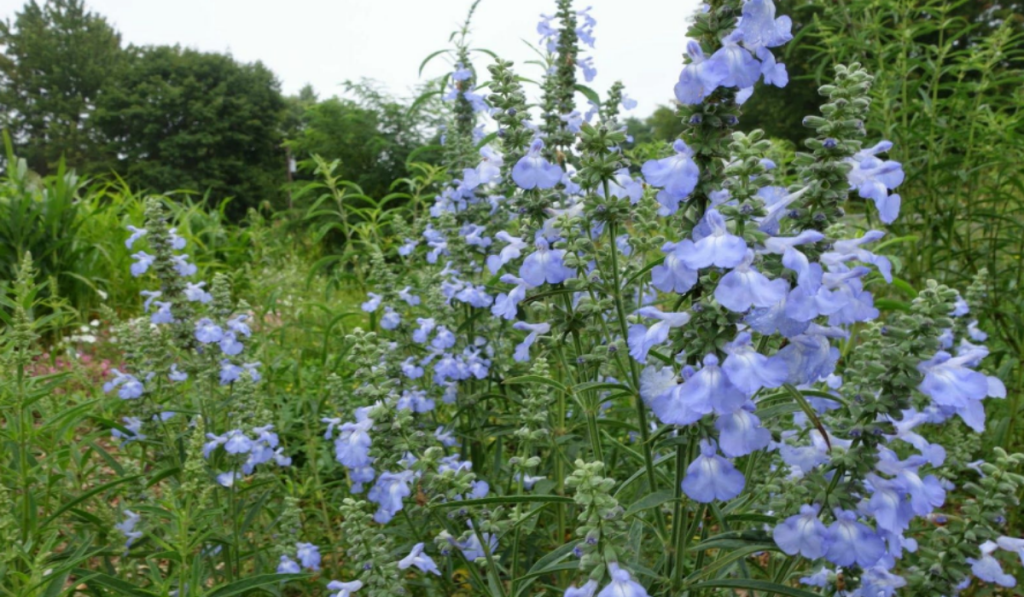
- Azure Blue Sage is a popular ornamental plant in perennial borders, meadows, native, rocky, and cottage gardens.
- It is grown in pollinator gardens as it attracts bees, butterflies, and hummingbirds.
- Due to its deer and drought-resistance abilities, Azure Sage is also a popular selection for xeriscaping and deer-resistant planting.
- It can be grown to restore meadows and prairies.
- Prairie Sage is used by indigenous communities as a traditional remedy for wound healing, tooth issues, and hormonal imbalance.
Impact on Farms and Environment
S. azurea is not considered a significant agricultural weed. The growth may occasionally occur on roadsides and grazed pastures, but its populations rarely overtake wanted vegetation or interfere with crop production. It also has no significant pest or disease problems.
The wildflower generally has a positive environmental impact as a critical pollinator plant, providing abundant nectar when other floral resources become scarce in late summer and fall.
It also improves prairie plant biodiversity and offers a sustainable solution in restoration projects because of its drought resistance abilities.
Control
- Mechanical control: Pulling, digging, and repeated mowing
- Chemical control: Selective herbicides like Dicamba, Triclopyr, and 2,4-D
Since Salvia azurea is a desirable plant, control is rarely necessary. However, where removal is desired, you can hand-pull the young plants before they flower to prevent seed production.
Digging out the crown and the entire root system can also help prevent regrowth. Another option for Azure Sage removal is frequent mowing to weaken populations. This strategy provides the best results when repeated over several growing seasons.
For dense populations, selective herbicides like dicamba, 2,4-D, and triclopyr can be used to suppress the wildflowers in managed landscapes. Ensure that you follow local regulations and the right timelines to avoid harming beneficial pollinators and surrounding native vegetation.

Lead Editor for Insight Weeds.