Salvia guaranitica is a herbaceous subshrub in the mint family that can grow up to 0.9-1.8 m with a spread of 2-5 feet wide in maturity. It is native to South America in habitats such as streambanks, forest borders, and open woodlands.
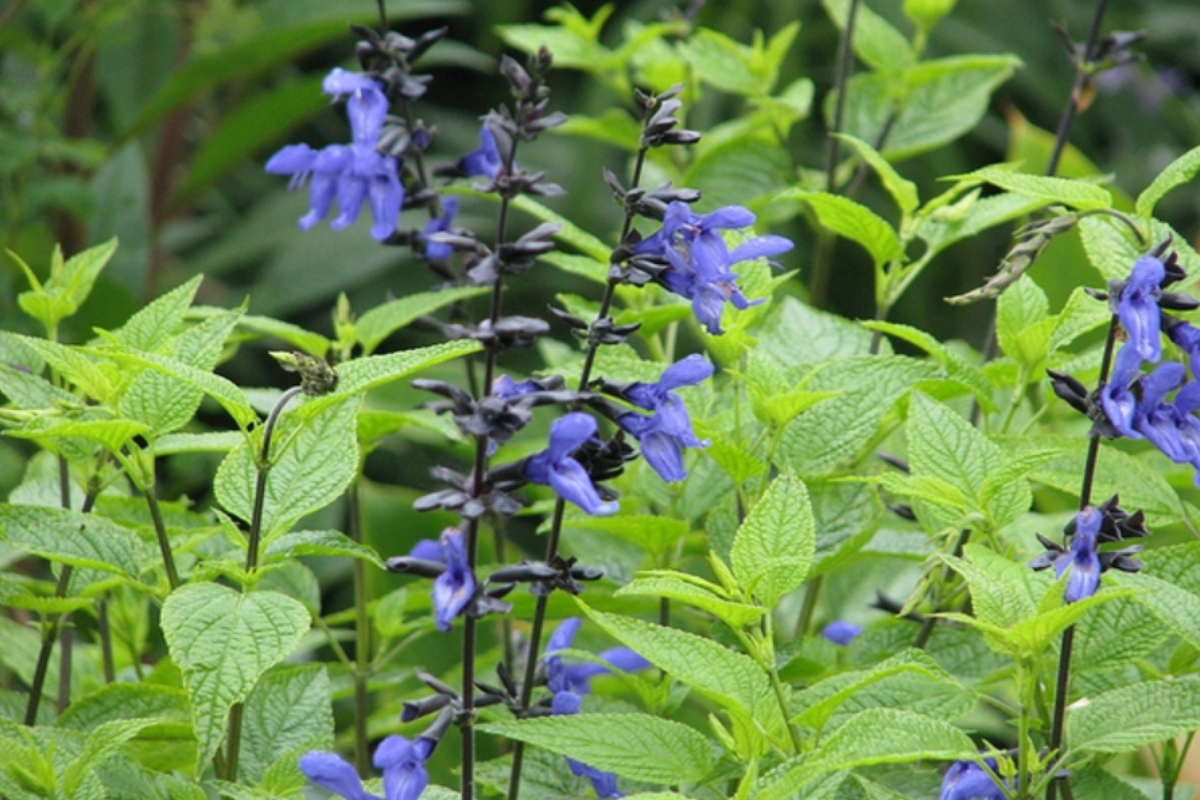
You can easily identify it by its showy, two-lipped, deep-blue blossoms, dark to purplish green stems, and wrinkled, ovate leaves with a minty scent.
Black and Blue Salvia Classification
- Domain: Eukaryota
- Kingdom: Plantae
- Phylum: Tracheophyta
- Subphylum: Angiospermae
- Class: Magnoliaspida
- Order: Lamiales
- Family: Lamiaceae
- Genus: Salvia
- Species: Salvia guaranitica
- Common Names: Anise Sage, Anise-Scented Sage, Brazilian Sage, Blue Anise Sage
Nativity and Distribution
Anise Sage is native to South America, particularly Brazil, Uruguay, Paraguay, and Northern Argentina. Today, the species has been widely cultivated in many temperate and subtropical regions globally, including North America, Europe, and Australia.
Physical Characteristics
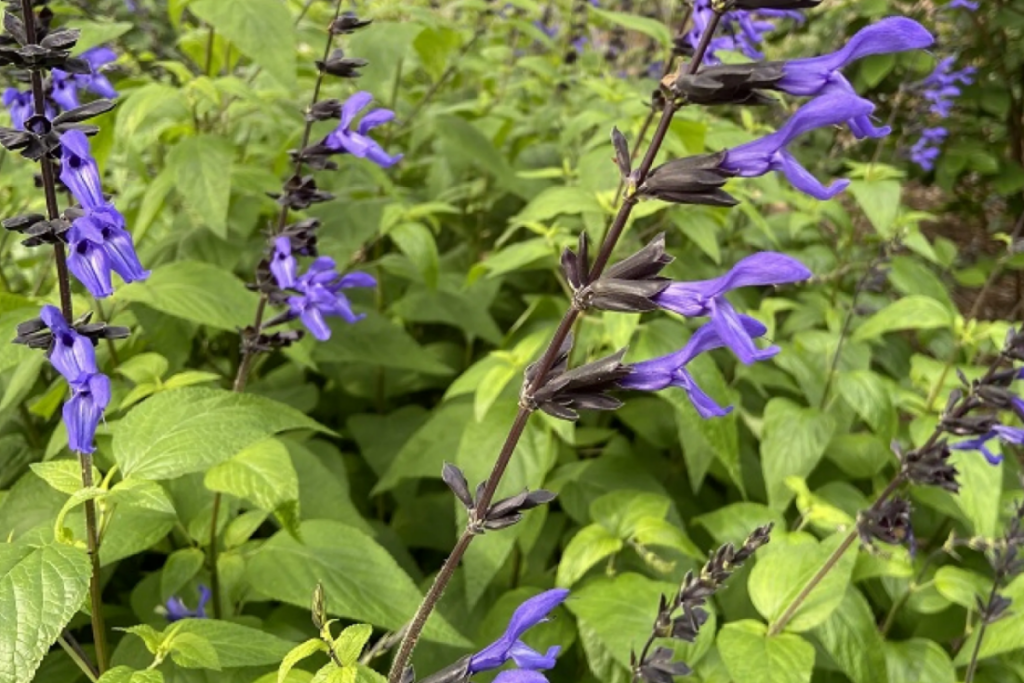
- Leaves: Opposite, ovate, medium to dark green in colour, 5-12 cm long
- Fruits: Four-lobed schizocarp, 2.5 mm, brown to black in colour
- Stems: Upright, square, purplish green to dark near the flowering areas
- Flowers: Showy, deep blue, two-lipped tubular flowers, 2.5-5 cm long
- Roots: Fibrous root system
Black and Blue Salvia is a herbaceous perennial subshrub in the mint family that can grow up to 0.9-1.8 m with a spread of 2-5 feet wide in maturity. It is identified by its showy, two-lipped, deep-blue blossoms, dark to purplish green stems, and wrinkled, ovate leaves with a minty scent.
Stems are upright, square, ridged, hairless, and purplish green to dark near the flowering areas. Young stems are typically flexible, becoming woody at the base as they mature. They are also accompanied by rhizomes that allow the plant to spread horizontally and regenerate after dormancy.
Anise Sage leaves are opposite, ovate to triangular-ovate, dark green on the top side and medium green on the underside, about 5-12 cm long. The leaf surface is wrinkled and pointed, with serrated margins.
When crushed, the foliage produces a mild anise scent, hence the name Anise-Scented Sage.
S. guaranitica produces showy, deep, two-lipped, cobalt-blue flowers 2.5-5 cm long. The tubular blooms are borne in terminal racemes, 25-35 cm long, and appear in sequence over an extended period of time.
The seeds are small (poppy-sized), dark brown to black in colour.
Reproduction, Dispersal, and Life Cycle
- Life Cycle: Perennial
- Seeds: A single plant may produce a few hundred seeds per season
- Climate: Thrives best in subtropical and warm temperate climates
- Dispersal: Falling, water, animals
Salvia guaranitica is a herbaceous perennial that resumes growth through crowns in spring, flowers in midsummer, with the top portions dying back in colder months.
The seeds develop within four nutlets in the calyx. The majority are dispersed by falling beneath the parent plant for germination, while the rest are dispersed by animals and moving water.
Since the wild plant’s seed production is inconsistent to support horticultural production, the plant is propagated through rhizomes.
Black and Blue Salvia thrives in humid subtropical and mild temperate climates. It prefers full sun to partial shade, humus-rich, evenly moist, and well-drained soil.
The perennial can tolerate medium drought once established but prolonged freezing temperatures may damage the rhizomes and crowns.
Similar Plants
- Salvia azurea
- Salvia farinacea
- Salvia nemorosa
- Salvia leucantha
- Salvia mexicana
Uses
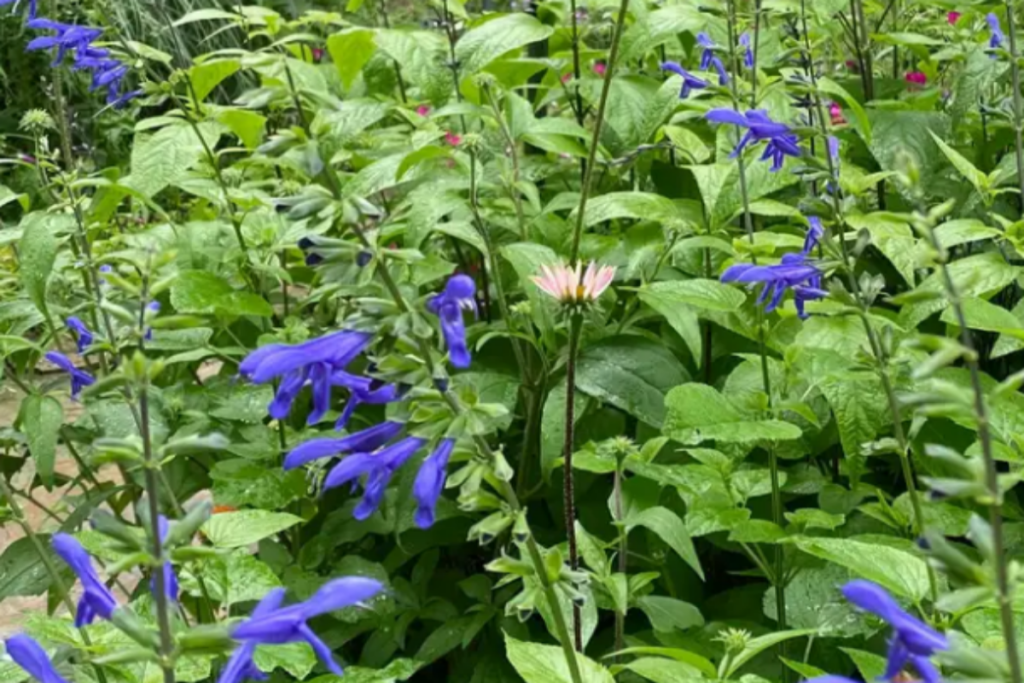
- Brazilian Sage is a popular ornamental plant, often planted in mixed beds, borders, and cutting, cottage, and rock gardens.
- It is a strong pollinator plant and hence grown in pollinator gardens to support hummingbirds, butterflies, bees, and other beneficial insects.
- It is a popular addition for water-wise landscaping as it can withstand mild drought and deer browsing once established.
Impact on Farms and Environment
Salvia guaranitica is not considered an agricultural weed as it hardly interferes with desirable plants. Its ability to attract pollinators can prove beneficial to desirable fruit and vegetable crop farms.
However, the perennial is prone to insect problems with aphids, whiteflies, and spider mites being the most common predators. Disease problems include rust, stem rot, and fungal leaf spot. If planted close to desirables, routine checks and quick control measures should be implemented to prevent the spread of the insect and disease problems.
Its prolonged blooming period makes Anise Sage a reliable source of food for pollinators in late summer through to autumn, thereby contributing to biodiversity and supporting local wildlife populations.
Control
- Mechanical control: Hand-pulling and cutting
- Chemical control: Broadleaf herbicide application
Where quick removal is desired, hand-pulling and digging out the established clump can provide effective results. Ensure that you dispose of the rhizomes correctly, as remaining fragments may resprout.
In managed gardens, cutting the clumps down to size or removing them entirely during dormancy is recommended.
Cutting the stems before flowering and seed production can also limit the spread of the shrub. However, repeated treatments are necessary during the growing season to achieve effective control.
Where manual removal is not a viable option, spot treatment of broadleaf herbicides like 2,4-D, Dicamba, glyphosate, or MCPA can help eradicate the unwanted plants.
The herbicides should be applied according to the instructions provided to avoid negative impact on pollinators and desirable ornamentals or crops.

Lead Editor for Insight Weeds.