Chromolaena odorata is a fast-growing, perennial multi-shrub in the Asteraceae family. The weed can grow up to 2.5m tall in open areas and 10m when climbing on other plants.
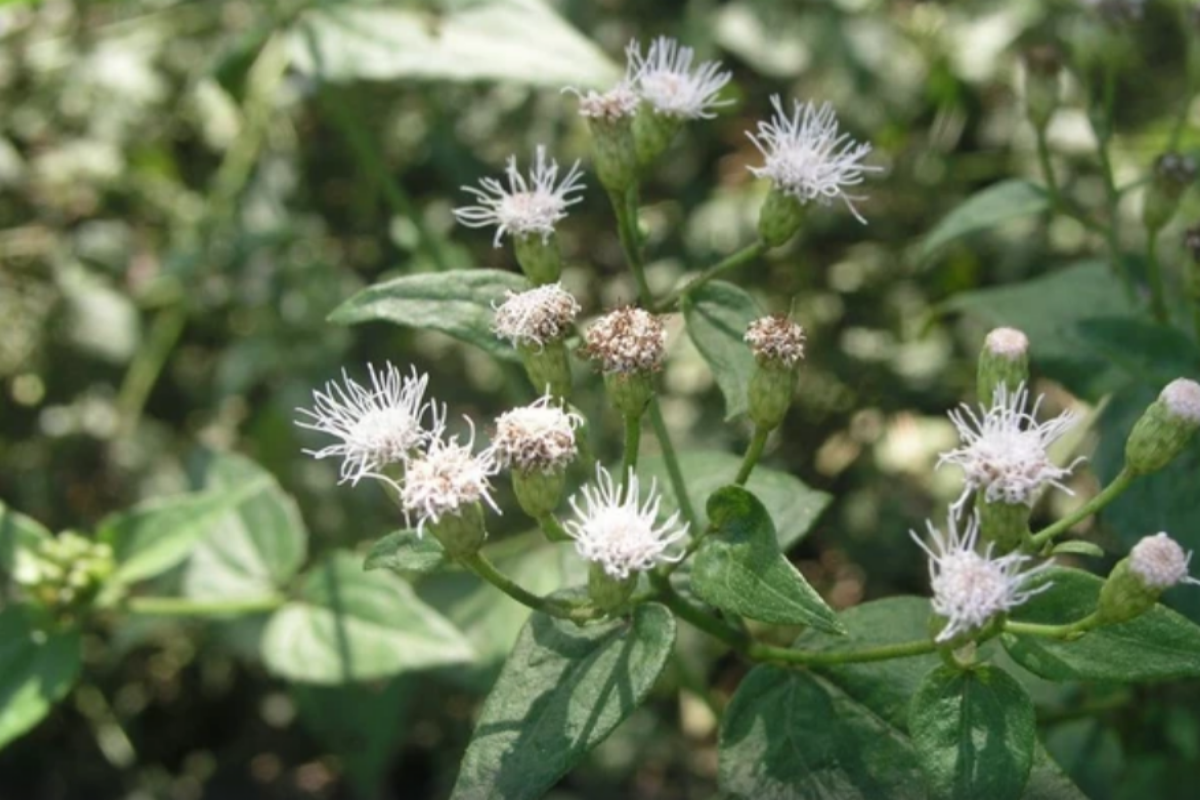
It is easily recognizable by its triangular, aromatic, velvety-haired leaves and pale pink to white tubular flowers. The Devil Weed has become one of the most troublesome weeds, invading pastures, crop lands, forest edges, plantations, and abandoned sites.
Devil Weed Classification
- Domain: Eukaryota
- Kingdom: Plantae
- Phylum: Tracheophyta
- Subphylum: Angiospermae
- Class: Magnoliaspida
- Order: Asterales
- Family: Asteraceae
- Genus: Chromolaena
- Species: Chromolaena odorata
- Common Names: Siam Weed, Christmas Bush, Jack in the Box, Triffid Weed, Bitter Bush, and Acheampong Leaves.
Nativity and Distribution
Siam Weed is native to the tropical and subtropical Americas, including Texas and Florida in the United States, Mexico, and the Caribbean.
Today, the perennial has been introduced to other regions, including West Africa, Asia, and parts of Australia.
Physical Characteristics
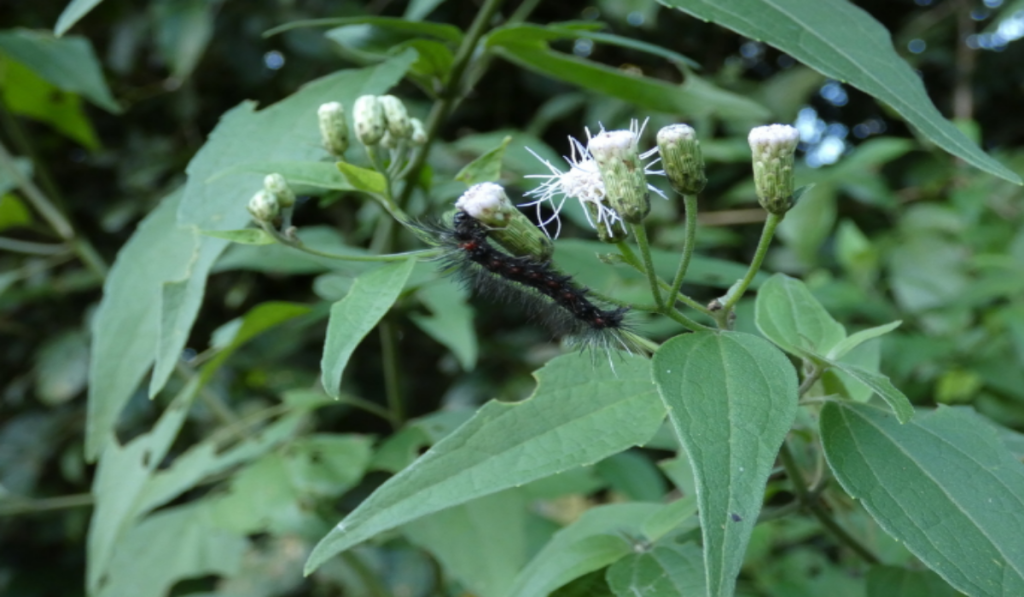
- Leaves: Opposite, triangular to elliptical, with serrated edges, 4-10 cm long
- Fruits: Black to dark-brown, achene with a pappus, 4-5mm long
- Stems: Upright, soft, green with fine hairs, upper stems, and woody at the base
- Flowers: Small, pale pink to white tubular blooms
- Roots: Fibrous root system
Chromolaena odorata is a fast-growing, perennial multi-shrub in the Asteraceae family that can grow between 2.5m in open areas to 10m when climbing on other plants. You can recognize the plant by its triangular, aromatic, velvety-haired leaves and pale pink to white tubular flowers.
Stems are mostly upright, green, soft on the upper side and woody at the base, with fine hairs. When located in shady areas, the plant behaves as a creeper, climbing neighboring vegetation for support, achieving a height of up to 10m.
Siam Weed leaves are opposite, triangular to elliptical, about 4-10 cm long and 1-5 cm wide, with serrated edges. They feature three prominent veins that run from the leaf base, resembling a pitchfork, hence the name, Devil Weed. When crushed, the leaves emit a strong, pungent odor, which inspires the name ‘odorata’.
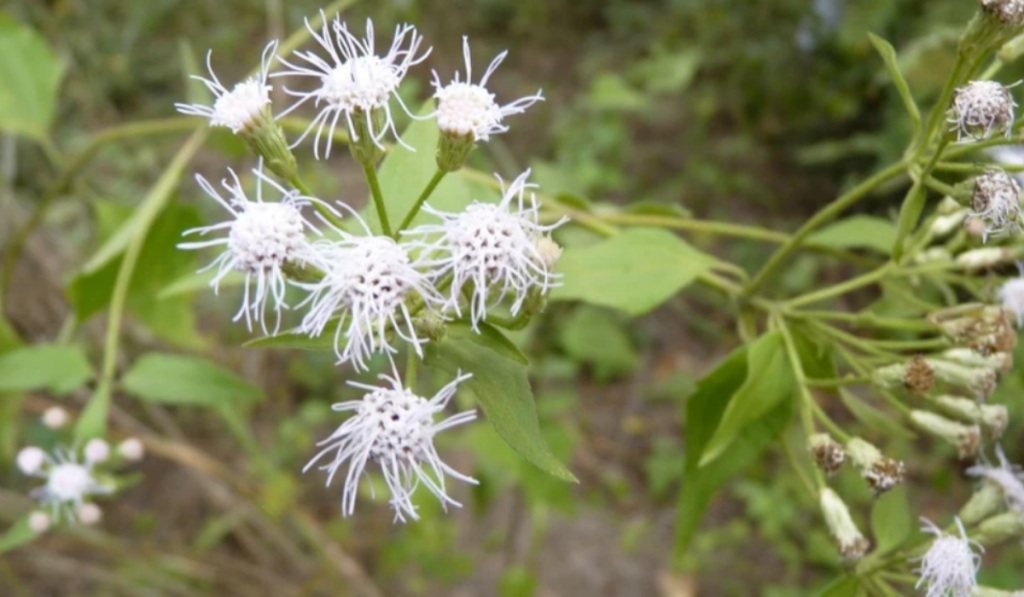
C. odorata produces small, tubular flowers borne on dense terminal clusters, with each holding about 10-35 blooms. Individual florets range from pale pink, lavender, or white and are an important source of nectar. Flowering occurs in the cooler or drier months, depending on the environment.
The seeds are small, narrow, elongated achenes, dark brown to black, with pappus (whitish brown bristly hairs), and about 4-5 mm long.
Reproduction, Dispersal, and Life Cycle
- Life Cycle: Perennial
- Seeds: A single plant can produce 80,000 to 1,000,000 seeds per season
- Climate: Thrives best in tropical and subtropical climates
- Dispersal: Wind, animal, and human activity
Chromolaena odorata behaves as a perennial shrub, often surviving for many years. Seedlings grow rapidly during favorable conditions (sometimes up to 3 cm a day) and mature plants flower annually. The upper parts of the plant die off eventually, leaving behind the roots and lower stems for regeneration.
Siam Weed is a prolific seed producer, with each plant producing 80,000 to over 1,000,000 seeds per growing season, depending on the environmental conditions and plant size.
The seeds have bristly hairs (pappus) that allow them to be carried off to long distances by wind currents. They are also dispersed by animals and human activity through contaminated vehicles, machinery, seed, and movement of soil. The species also reproduces by vegetative means through nodding at the branches.
C. odorata seeds have a 30%-60% viability, with only 2% germinating immediately, while the rest go into dormancy. The weed prefers tropical and humid subtropical climates, thriving in full sun and partial shade. It is common in open areas, forest edges, pastures, crop lands, plantations, and abandoned sites.
Similar Plants
- Praxelis clematidea
- Mikania micrantha
- Eupatorium serotinum
- Choromolaena uvifolium
- Chromolaena squalida
Uses
- The plant is used to prepare traditional medicine for treating minor skin infections, wounds, and burns.
- It is used as a remedy for diarrhoea, fever, toothaches, headaches, and liver ailments.
- Crushed leaves are rubbed on the skin to prevent leech attacks in tropical countries.
- In Africa, the boiled herb is used for cough relief, and when mixed with guava and lemongrass, it is used for protozoan infections.
- The leaves are consumed as a vegetable for their rich nutritional profiles, including fiber, protein, and essential minerals.
- C. odorata is used as green manure in some agricultural systems.
- It can be planted in degraded lands to prevent soil erosion, although under strict supervision.
Impact on Farms and Environment
Siam Weed is considered a serious weed in agricultural systems. It typically affects perennial crops such as coffee, cocoa, palm, sugarcane, teak, and rubber. Since it is a fast-growing plant and domineering in terms of spacing and nutrient competition, it can smother desirable crops.
In shifting cultivation, it may be a preferred weed as it is easier to clear and can prevent the growth of other pesky weeds like Imperata cylindrica. However, this fallow system measure should be taken with caution as its risks far outweigh the benefits.
The weed hosts insects like the Variegated Grasshopper (Zonocerus variegatus) and other pathogens that can affect crop leaves, flowers, and fruits, reducing crop yield and quality.
Chromolaena odorata also invades pastures, reducing cattle carrying capacity. It easily overtakes overgrazed areas, yet it is toxic to cattle because the leaves contain high nitrate levels.
In forest edges, riverbanks, wildlife reserves, and other natural habitats, Siam Weed can displace native vegetation, negatively impacting biodiversity and threatening livelihoods.
The species’ impenetrable thickets can also be a fire hazard in regions with prolonged dry seasons.
Control
- Mechanical control: Hand-pulling and digging
- Cultural control: Establish competitive pasture grasses
- Biological control: Introduction of mites and moth larvae
- Chemical control: Application of herbicides such as glyphosate and triclopyr
Hand-pulling is a viable option for removing seedlings and young plants. The root system must be dug out to prevent regrowth. Two repeat clearances are also recommended every growing season to ensure effective control. Applying herbicides like triclopyr at this stage can also enhance weed control.
In pasture lands and perennial plantations, introducing competitive pasture grasses, native competitive weed species, and dense ground cover crops has been shown to reduce seed establishment.
Several attempts to introduce biological agents for C. odorata have shown limited but promising results over the years. These include the seed-feeding weevil, Apion brunneonigrum, in West Africa and Asia, and Pareuchaetes Pseudoinsulata, in South Africa.
More research is ongoing to find biological control agents that can provide effective control against all strains of the weed across all continents.
Systemic herbicides containing active ingredients like glyphosate and triclopyr can suppress infestations if applied in the early growth stages. However, several repeat applications are required to counter resprouting from seed banks.

Lead Editor for Insight Weeds.