Forget-Me-Nots are low-growing to erect plants that can achieve a height of 15-50 cm. The foliage is covered in soft hairs that give it a greenish-gray appearance.
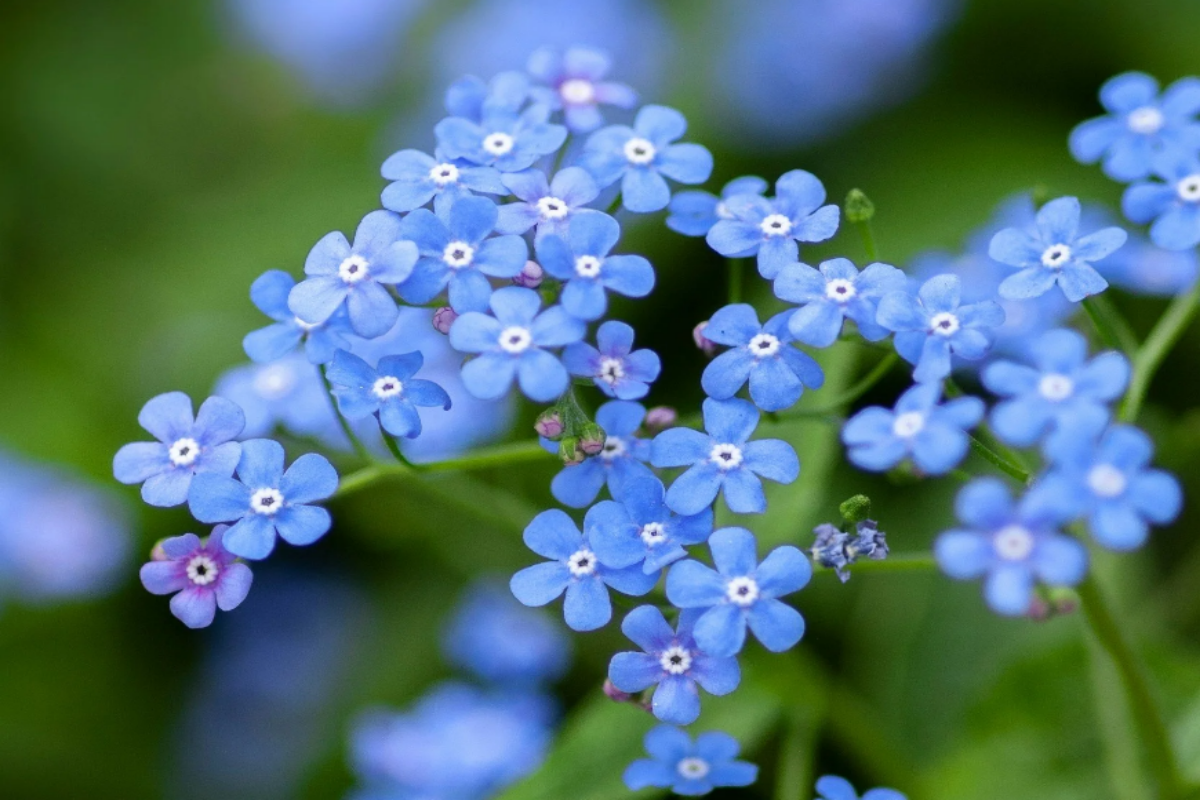
They can be easily identified by their vibrant five-petalled flowers, typically blue but can also be found in white or pink shades. The flowers are borne on coiled racemes that uncurl as the flowers bloom.
Myosotis/Cynoglossum is native to temperate Asia, Europe, and parts of North Africa.
Forget-Me-Not Classification
- Domain: Eukaryota
- Kingdom: Plantae
- Phylum: Tracheophyta
- Subphylum: Angiospermae
- Class: Magnoliaspida
- Order: Boraginales
- Family: Boraginaceae
- Genus: Myosotis/Cynoglossum
- Species: Myosotis spp./Cynoglossum spp.
- Common Names: Forget-Me-Not, Scorpion Grass, Chinese Hound’s Tongue
Nativity and Distribution
Forget-Me-Nots are native to Temperate Asia, Europe, New Zealand, and parts of North Africa. However, due to horticultural trade and accidental movements, several species can be found in South Africa, parts of the United States, and Australia.
Physical Characteristics
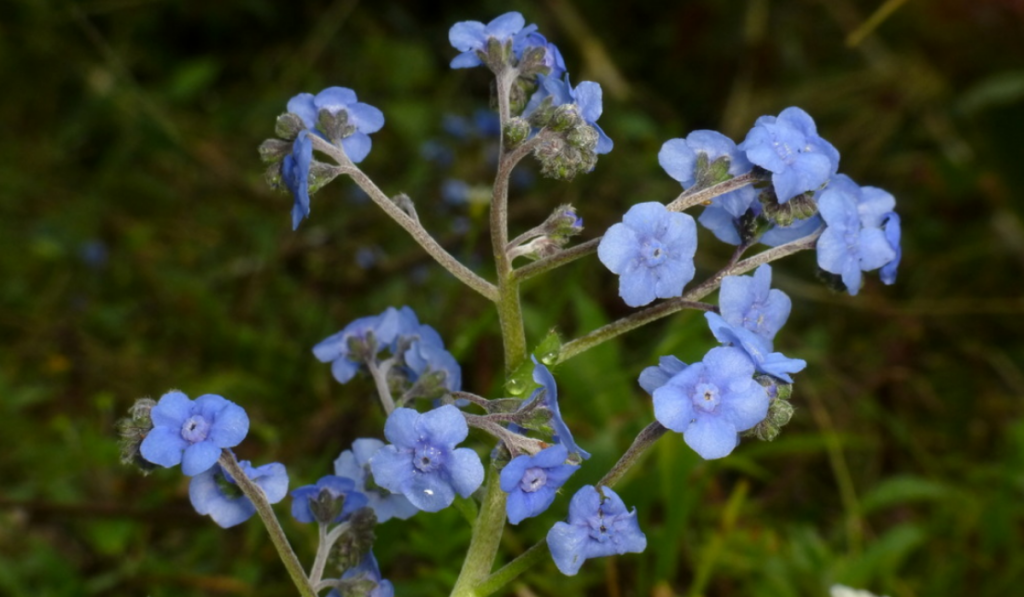
- Leaves: Simple, alternate, oblong to lance-shaped, and about 1-10 cm long
- Fruits: Narrowly ovoid cluster of smooth nutlets 1-3mm long
- Stems: Creeping or erect, typically 15-50 cm long
- Flowers: Flat, five-petalled flowers with white or pink centres
- Roots: Fibrous root system
Forget-Me-Nots are biennials or perennial herbaceous flowering plants in the borage plant family. They have erect to spreading, or creeping stems that can grow 15-50 cm long depending on the species.
You can identify the plants by their narrow, oblong to lance-shaped leaves, tiny, sky-blue, white, or pink five-petalled blossoms and saucer-shaped corollas.
Stems are erect to spreading, or creeping to branching, and can reach 50 cm in height for species like the M. sylvatica. They are slender and covered in small, fine hair that gives them a greenish-gray hue.
Forget-Me-Not leaves are simple, alternate, and sessile on the upper stems. The leaves on the bottom may form a basal rosette with short petioles. Leaf blades are narrow, oblong to lance-shaped, about 1-10 cm long, with prominent midveins and smooth margins.
Myosotis/Cynoglossum plants produce small, five-petaled flowers with rounded petals fused at the base. They are typically 5-8 mm in diameter. The most common Forget-Me-Nots are sky blue in colour with prominent white, pink, or yellow centres. However, some species produce white or pink flowers.
These flowers are borne on elongate cymes that gradually uncoil as blooms open in spring through to early summer.
The herbaceous plants produce small, flat, tear-drop shaped seeds that turn dark-brown or black in maturity. In some species, the seeds may have burs for easy attachment during dispersal.
Reproduction, Dispersal, and Life Cycle
- Life Cycle: Annual, biennial, or perennial
- Seeds: A single plant can produce 1,600 seeds
- Climate: Thrives best in cool, temperate climates
- Dispersal: Birds, animals, water, and humans
The life cycle of Forget-Me-Nots varies by species. However, most of the species, including Myosotis arvensis, Myosotis scorpioides, and Myosotis sylvatica, are short-lived biennials or perennials. For the biennials and short-lived perennials, this means that they grow vegetatively in the first year and set seed in the second year before dying.
The seeds are mainly dispersed by birds, animals, and humans. The seeds contain burs that attach to fur, feathers, and clothing enabling wider dispersal. The commercial sale of the plants has also propagated the introduction of the species into new habitats.
Other species like the Myosotis scorpioides, also known as the Water Forget-Me-Not, develops through rhizomes and stolons that root at the nodes, enabling it to anchor in waterlogged soils and spread vegetatively.
These species thrive in cool, temperate climates with adequate moisture and shade. They thrive best in spring when temperatures are mild and do not tolerate hot, dry, or tropical conditions.
Similar Plants
- Myosotis discolor
- Cynoglossum amabile
- Borago officinalis
- Veronica spp.
Uses

- The plants are used as spring ornamentals in wildflower meadows, rock gardens, woodland gardens, and as border plants.
- Forget-Me-Nots are grown as ground cover in daffodil and tulip plantations to suppress weeds.
- The flowers are grown in pollinator gardens as an early-season pollinator resource.
- In Europe, the plant is used as a traditional remedy for coughs, lung ailments, nosebleeds, and early onset symptoms of malaria.
- The flowers are edible and used in decorating baked goods and salads.
- The flowers are cut and prepared as floral arrangements in memorials and funerals in Europe.
Impact on Farms and Environment
While the Forget-Me-Nots are beloved spring plants in their native environments, introduced species can have significant ecological and agricultural impacts, especially if they escape the designated areas.
Dense infestations are known to modify stream waterflow and to displace native vegetation. These may include understory herbs, sedges, and wildflowers, reducing plant diversity and altering community structure. Myosotis scorpioides, in Wisconsin, for instance, threatens the spike sedge (Eleocharis intermedia) and other wetland plants through resource competition.
As pollinator plants, they can significantly alter native pollination dynamics by drawing away bees and other insects from native plants, leading to a decrease in native plant variety.
The seeds have a prolonged dormancy of up to 30 years. This can make eradication difficult to achieve, allowing populations to re-establish even after years of constituent removal efforts.
Consequently, they are a persistent weed in crop fields and pastures. The prolific seed production and long seed dormancy often lead to expensive and prolonged eradication efforts that may not yield much success.
Some species contain pyrrolizidine alkaloids that cause livestock toxicity, including liver damage if consumed in large quantities.
Control
- Mechanical Control: Hand removal and hoeing
- Chemical Control: Apply herbicides 2,4-D, MCPA, and Chlorsulfuron
For small infestations, carefully pull the entire plant from the root as the stems tend to break easily. This will prevent further growth as well as seed set. Bag the material and do not compost it, as the seeds may be viable.
Hoeing or cultivation is a viable weed removal option in agricultural settings. Disturb the soil before flowering to prevent seed set. However, if this is a recurring infestation, keep in mind that disturbing the soil may stimulate germination of soil-stored seeds.
Selective broadleaf herbicides like 2,4,D and MCPA can be applied in early winter to provide effective control in non-crop settings like pastures.
For broad scale control, repeated application of sulfonyl urea herbicides like chlorsulfuron for at least three years has shown promising results in broad-scale control of M. sylvatica.
Given the prolonged seed bank dormancy, long-term treatment and monitoring is highly recommended several years after the initial removal.

Lead Editor for Insight Weeds.