Nigella damascena is an annual herbaceous plant that belongs to the buttercup family, growing about 20-50 cm. It is typically found in fields, alongside roadsides, and rocky areas.
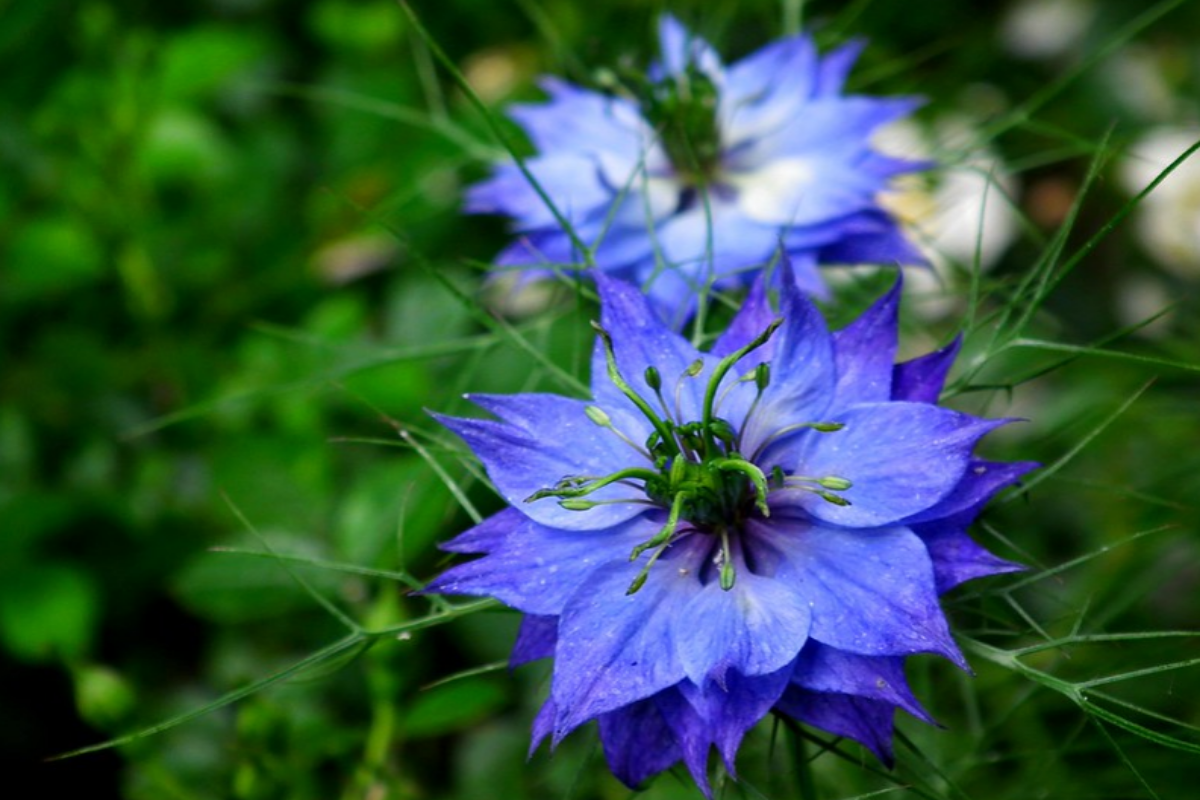
You can easily recognize the plant by its finely cut, bright green fennel leaves and solitary, showy, pale to bright blue flowers borne at the tips of stems and branches.
Love-in-a-Mist is native to southern Europe, North Africa, and southwest Asia.
Love-in-a-Mist Classification
- Domain: Eukaryota
- Kingdom: Plantae
- Phylum: Tracheophyta
- Subphylum: Angiospermae
- Class: Magnoliaspida
- Order: Ranunculales
- Family: Ranunculaceae
- Genus: Nigella
- Species: Nigella damascena
- Common Names: Love-in-a-mist, Ragged Lady, Fennel Flower, Jack-in-the-Green, and Katharine’s Flower
Nativity and Distribution
Love-in-a-Mist is native to southern Europe (France, Italy, Greece, Spain coastlines, and the Balkans), North Africa (Algeria, Morocco, and Tunisia), and Southwest Asia (prominently found in Lebanon, Syria, and Turkey).
It has also been naturalized in other regions, including Australia, South Africa, New Zealand, and North America.
Physical Characteristics
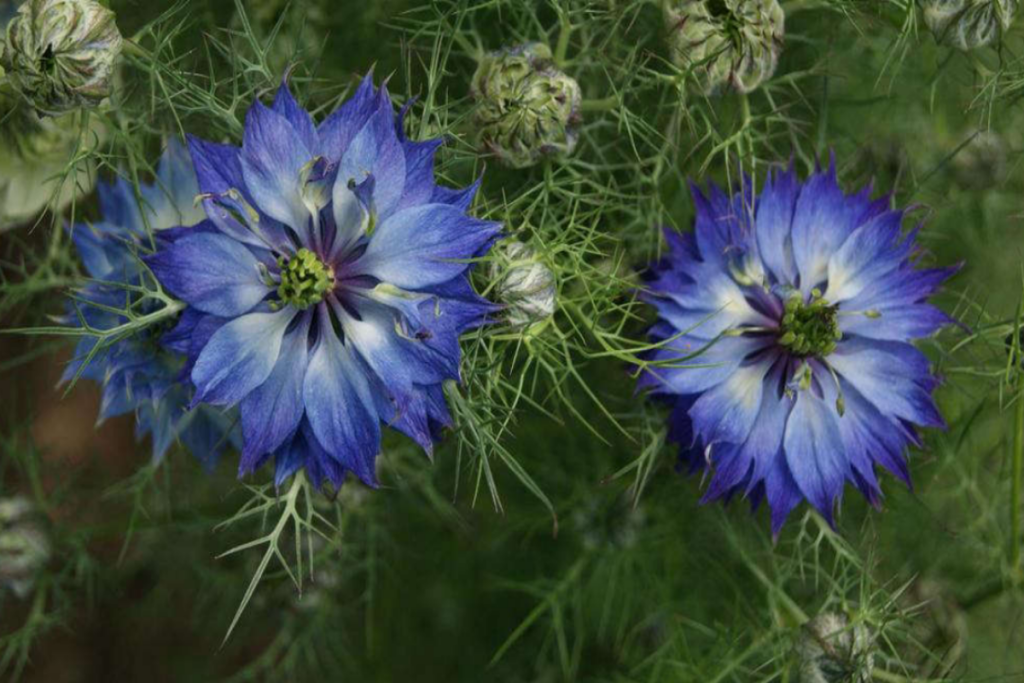
- Leaves: Alternate, feathery, with a fennel-like appearance, and grow up to 1.5 cm long
- Fruits: Large, balloon-like capsule about 2-5 cm long
- Stems: Erect, glabrous, angular in cross-section, 20-70 cm tall
- Flowers: Solitary, 2-4 cm wide with showy 5-25 petal-like sepals
- Roots: Tap root system
Fennel Flower is a small to medium-sized annual herbaceous plant that grows 20-50 and up to 70 cm in cultivated gardens. It is a beloved cottage flower in temperate climates and is easily recognizable by its solitary blooms and fennel-like leaves.
Stems are erect, slender and sometimes branching at the top and can grow 20-50 cm. In cultivated gardens, the plant can grow up to 70 cm long. They are glabrous, finely ridged, angular in cross-section, and green to blue-green in colour.
Love-in-a-Mist leaves are bright green, finely cut into narrow, thread-like segments up to 1.5 cm long, giving it a feathery fennel-like appearance. Basal leaves are more linear and tend to get more finely divided up the stem.
The uppermost leaves form a lacy collar that surrounds the flower, which is a distinctive feature for this species.
Nigella damascena produces solitary flowers borne on the tips of stems and branches, about 2-4 cm wide. They are typically bright blue to pale blue but can also appear in shades of pink, lavender, or white depending on the cultivar.
The showy coloured parts are 5-25 petal-like sepals. True petals are inconspicuous and located at the base of numerous stamens. The flower centre features multiple stamens surrounding a compound pistil of about 4-7 erect carpels. Flowering occurs in late spring through summer, depending on the prevailing environmental conditions.
The seeds are small, 2-3mm long, egg-shaped, wrinkled, and intensely black in colour.
Reproduction, Dispersal, and Life Cycle
- Life Cycle: Annual
- Seeds: A single plant can produce over 1,000 seeds
- Climate: Thrives best in cool to mild temperate climates
- Dispersal: Explosive mechanism, water, animals, and contaminated soil
N. damascena is a true annual, completing its entire cycle within a single growing season. Each plant can produce several hundred or thousands of seeds that are mainly dispersed through explosive mechanism, water, or contaminated soil.
Germination occurs in autumn to early spring when temperatures are cool. It prefers full sun, well-drained, and moderately fertile soil. The plant can tolerate a range of soil types from sandy to clay-loam. Once the seeds ripen, the plant dies due to the increased temperatures.
Love-in-a-Mist can tolerate frosty weather but does not tolerate waterlogging and humid or hot conditions.
Similar Plants
- Nigella sativa
- Nigella arvensis
- Nigella hispanica
- Foeniculum vulgare
Uses
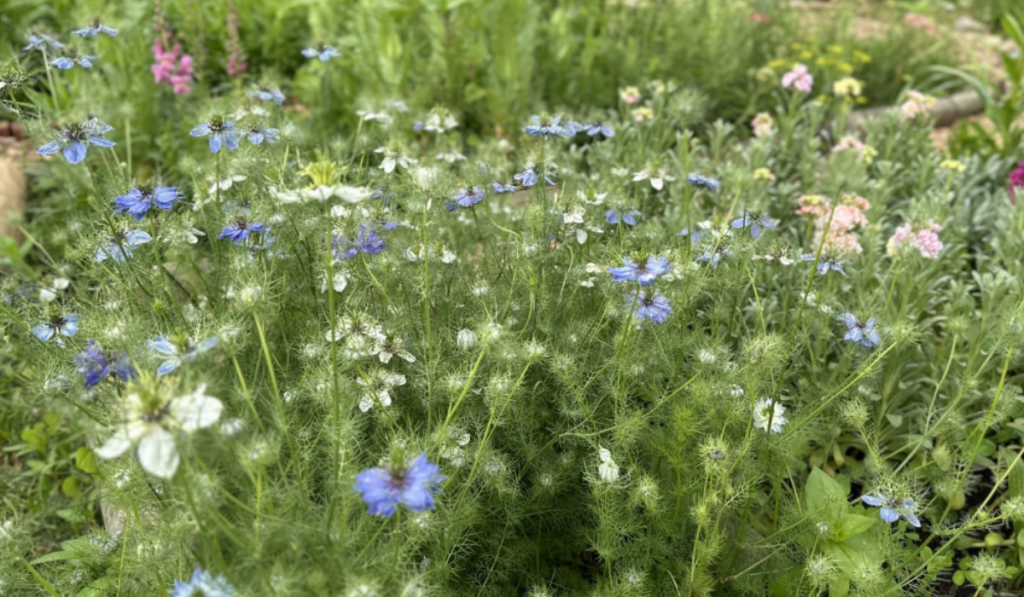
- Love-in-a-Mist is used as an ornamental in cottage gardens, rock gardens, borders, cutting gardens, and in pollinator gardens.
- The seeds are aromatic and are used as a flavouring agent on bread and cheese in North Africa and along the Mediterranean.
- The plant is used in traditional medicine for fever management, regulating menstruation, nasal decongestion, and easing digestive problems.
- Ripe seed capsules are used as a food source for birds like finches and sparrows.
- The seeds are used to make an essential oil that inhibits enzymes that propagate chronic inflammation and tissue damage.
Impact on Farms and Environment
Nigella damascena is considered a low-risk weed in terms of invasiveness and agricultural impact. However, where dense infestations occur, it can crowd out desirable plants and outcompete seedlings in disturbed soil.
Since the buried seeds can remain viable for several years, re-emergence in cultivated fields and seedbeds may require prolonged and expensive management.
In non-native environments, the plant can escape cultivation and invade areas such as roadsides, rocky and waste areas, and other disturbed sites.
All parts of the plant contain alkaloids that can cause mild toxicity in humans and livestock. It is recommended that you follow professional guidance when using the plant for medicinal purposes.
Control
Mechanical Control: Hand-pulling, hoeing, and mulching
Love-in-a-Mist is a non-aggressive plant that also features a shallow tap root, making it easy to eradicate. Pulling the seedlings or young plants from the roots is the best option. Ensure that you dispose of the seed capsule material.
Other effective options include shallow hoeing of seedlings in spring or laying a thick layer of mulch to suppress germination of self-sown seedlings. This will also reduce the need for repeated handweeding.

Lead Editor for Insight Weeds.